Sunday, May 15, 2011

Nest Count 2011

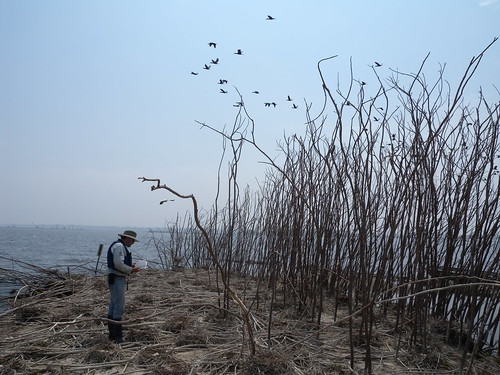
Sumner Mattson (WDNR) counts doiuble-crested cormorant nests,
while adults fly overhead.
I remember wildlife specials on TV from of Florida and other tropical places, where slender white birds with long plumes perched in flimsy nests.  There were strange looking black birds, and others had white long bills and yellow pouches they dipped in the water to scoop up fish.  Now those far places are here, they are on the islands of our lakes, and even within our cities.  It isn’t some new strange phenomenon, but the return of fish-eating birds after the banning of DDT and unregulated hunting.  Pelicans are experiencing a natural expansion of their range, and may have been present here pre-settlement.  These water birds are back and in some areas more numerous than they were 200 years ago, so it is a good idea to keep tabs on them.  With current staff there are too many sites to survey, but the Wisconsin Department of Natural Resources surveys some.  I helped with a survey on May 12, 2011 on Lake Butte des Morts.

American white pelican on Lake Butte des Morts,
Winnebago County nest made of gravel. 
The nesting colonies are truly fascinating places.  I saw all those “Florida birds” from TV:  white pelicans, double-crested cormorants, great egrets, black-crowned night herons, great-blue herons, and cattle egrets.  I walked among hundreds of nests, thousands of eggs, and was surrounded by birds taller than my seven year-old anxiously waiting for me to leave.  There is a certain awe being surrounded by so much life, so many eggs about to hatch, in such a foreign landscape.  However, most sane people would stay far from here.  Our nesting colonies are like those anywhere else that seabirds have nested for tens of millions of years, and there is much that makes all nesting colonies unpleasant.  American White Pelicans are very large and weigh about 16 lbs. and their big feet trample everything.  They even flatten cattails to make an area suitable for nesting.  Then there is the obvious:  a few thousand birds defecating in the same place day after day along with rotting fish and birds, producing an awful stench and polluting the surrounding water.  Many of these birds nest in trees, but eventually they produce so much nutrient-rich guano that they kill all the vegetation on these islands including the trees they nest in.   After spending several hours the fetid air began to make me weak and I could start to feel a burning sensation in my lungs. 
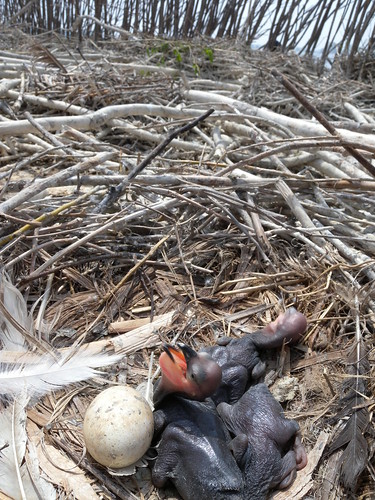
Cormorant chicks and eggs
It paints a nasty scene, both beautiful and revolting, but that’s nature.   Our lakes are as pretty as a postcard and the mosquitoes are as ruthless as the Russian mafia.  I don’t know how many cormorants or pelicans are too many, but it seems we have enough.  I don’t want too many of our islands, points and secluded areas to be polluted by species that congregate in numbers too many and produce so much pollution that they destroy their own habitat.  Species just like the one with the clipboard counting the nests. 


Nesting Colony
Subscribe to my YouTube Channel


Friday, May 6, 2011

No going back.


Fall Colors By Moonlight

I started this project in the winter, which can be a difficult time to come up with stunning landscape photos in flat marshes made more featureless with snow.  To get the project going on this blog and Flickr I searched through my archive of slides and digital photos.  One thing I realized was that there were many photos that I have taken over the years that I could not possibly retake in different light, or season.  Why?  Development has altered the landscape.  A house pops up here and there.  Some of the night photos I once took could no longer be done because of the spread of light pollution.  Although it seems I notice a new wrinkle every time I smile in the mirror, these photos are not old.  Most go back only ten to fifteen years.  I haven’t returned to these areas to photograph because sometimes it’s too aggravating or sad.

Slough Creek Sunrise

“Sunrise at Slough Creek” could not be taken again.  The barn is gone.  The big red barns are out dated for the modern farm, expensive to maintain and many are located at farms that are no longer operational.  So they fall much like the hay they used to store did to the sickle bar.  Behind where the barn used to be, two-lane Hwy 110 has been replaced by four lanes of Hwy 45 and 2 lanes of County Hwy S.  Highway 41 will soon loom even larger as construction of the 41/45 interchange continues.  The six lanes barely visible in the far horizon in 1998 will have turned into 12 in 2013.

Alfalfa No More

In the fields I used to frequent as a child there seems to have been some terrible mistake in crop rotation of corn, alfalfa, and soybeans.  Some crazy farmers have planted plastic beige and grey houses.  The first question every architect must ask a future home owner is what shade of beige or gray would you like your house to be.  No offense to those in beige houses--someone dropped my house and two dozen others on my street (most of them white and I’m sure made of old-growth white pine) in a farmer’s field a hundred years ago.  Same stuff different century.

Although not in one of our wetlands, this photo of a church is one of my favorites.  I’m about as religious as a moss covered rock, but I love the simple architecture of old rural churches.  This one sits all alone at the top of a hill.  I like the photo partially because it was taken in a -30 degree wind chill.  I guess I feel I earned it.  The spot where I took this photo is now home to an electrical substation.  I don’t think even a digital camera can photograph through a transformer. 
Development continues at a rapid pace.  When I surveyed plants and shorelines for the DNR in 2008 one marsh and two shorelines were destroyed within three months of my first visit.  So one of the things I’m trying to do with this project is to document changes in the landscape, natural and manmade.  When time and conditions allow I am using the GPS to geotag my photographs and get a compass heading.  Perhaps someone will come along years from now and wonder what’s changed, and be able to duplicate my photos.  Conservationists often use air photos to track changes in the landscape, but you can’t feel textures of hummocks dotting a sedge meadow from a satellite photo.  You can’t lament the loss of that meadow seen as a green spec from space that in a few years might break off as a floating mat and disintegrated in Lake Winnebago.  The same goes for the alfalfa field on a quiet foggy morning, or the wind playing with cattails in October.  
Country Church

Monday, May 2, 2011

Plant of the Week: Jack-in-the-pulpit (Arisaema triphyllum)


Jack-in-the-pulpit Wuakau Creek, WI

This common spring wildflower is easy to overlook in the moist woods and swamps where it is found.  However, once located it is an interesting if not beautiful wildflower.  The flower is formed in a special way called a spathe, reminiscent of carnivorous pitcher plants.  This is the flower of the plant and not a modified insect-eating leaf like that of the pitcher plant, although it often traps insects.  The plants produce flowers of different sexes depending on how much reserves are stored in an underground stem called a corm.  The fertilized female flowers produce a cluster of bright red berries in fall (Eastman 1992).

More about Jack-in-the-Pulpit

Friday, April 29, 2011

Spring Update #4: Sturgeon Spawning

Sturgeon fans can get up close to their favorite fish.
Wolf River Sturgeon Trail, New London, today (April 29, 2011)
fish were also active at Bamboo Bend, Shiocton 
Despite the cold spring the lake sturgeon (Acipenser fulvescens) have been spawning this week on the Wolf River and its tributaries.  The DNR has daily updates on its website.  If you can't make the trip upriver to see them in person you can always check the sturgeon cams.  Click on the locations to see if there are fish.  Sometimes you'll have to wait awhile, and as the water warms up during the day you should be able to see more fish.

Saturday, April 23, 2011

Spring Update 3: Everybody Hates Me

At the parking lot today (4/21/2011) there is a flock of tree swallows darting about low over the gravel, picking bugs out of the air and the ground.  They pay me little attention, but other things have changed in the marsh since my last visit.  There are still many migrants stopping over on their journey north, but there are also many animals that have set up firm territories where I am an unwelcome guest.  I spend my time in the marsh walking the dredge bank along a long narrow ditch.  It is not like a lake or pond where disturbed waterfowl can just swim away and maintain a comfortable distance.  As I walk I drive the animals forward until they have no place to go. 

Lethargic Wood Chuck
As I walk and listen to the calling leopard frogs I flush a mallard hen who I’m sure is sitting on a nest.  I look for the nest for a minute and am unable to find it.  While I walk I am also pushing a pair of mallards in front of me, until they finally take flight.  They circle and quack at me, and shortly they are joined by a Canada goose who circles and honks.  Up ahead are a half dozen blue-wing teal.  They are much quieter, but as I push them to where they can no longer swim they begin to peep-whistle to each other excitedly while spinning around in circles.  Then one decides he’s had enough, erupts from the water, and the rest instantly join him.   The goose and mallards have returned to their territories, but another goose is in the ditch and begins to signal a warning to the others in the marsh.  A pair of sandhill cranes flying overhead does the same.  With all these warning calls I barely notice the shabby looking woodchuck six feet in front of me.  It stands there on its hind legs before walking away.  The poor guy looks gaunt after a long hibernation and I have no doubt I could have caught him with my bare hands. 

DON'T LOOK AT ME! - Canada goose on nest
This chasing of wildlife repeats itself over and over.  I notice three goose nests on muskrat lodges with their dutiful parent spread completely flat, looking like a teenage girl sitting as low as possible in the backseat of her dad’s car as she gets dropped off at the mall.  These nests are in easy range of any predator, and if I spot them, any fox, raccoon, or opossum will surely find them.  Geese don’t give up their nests easily, though, and any of these predators and opportunists will have a fight on their hands should they have a hankering for goose eggs.

Eventually the ditch and bank dead end and I turn back the way I came.  I meet the same woodchuck and all the other birds who exclaim the warning “there is a stranger in our midst.”  I meet someone new just before I get to my car, a mink swimming ahead of me as fast as it can before launching out of the water and scurrying into the safety of a burrow.  The tree swallows still swoop around me.  They appreciate my scaring the midges into taking flight, but everyone else hates me.

Sunday, April 17, 2011

Plant of the Week??? Lichens

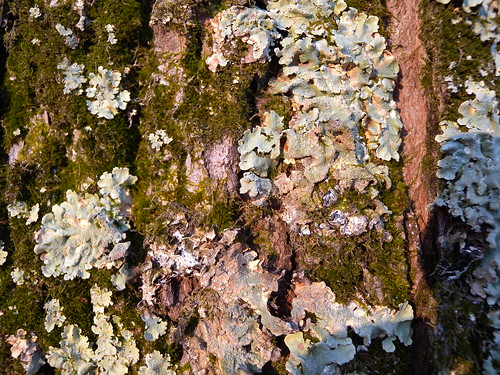
Lichen growing on willow bark

Lichens are not truly plants, they’re not even a single organism.  These crusty, sometimes mossy looking things growing on trees and rocks are actually an algae and a fungus living together.  The fungus (mycobiont) gets nutrients from its substrate and gives it to the algae (photobiont), and the algae makes food (carbohydrates) through photosynthesis and gives it to the fungus.  I use the word “gives” liberally, some would argue the organisms are stealing from each other. 

Lichens live in some harsh places on earth, surviving intense ultraviolet radiation and temperatures in excess of 130°F, and eat bark and rocks.  That’s pretty hardcore.  That makes it ironic that they are good indicators of pollution.  Lichens are susceptible to pollution found in rain and the air.  They have no true roots and must take in all their moisture from the air.  They don’t have the luxury of the filtering effects of soil.  I don’t really think of Oshkosh as a big dirty city, but its lack of lichen diversity indicates that there is more pollution than the countryside.  Today, pollution is less visible.  We might not notice any sources if it were not for the water vapor visible from our tail pipes and furnace exhaust on cold days, but it is there and does have an effect on everything and everyone including the toughest organisms on earth.  

Lichen growing on living ash bark

Tuesday, April 12, 2011

A Terrible Time for Muskrats

This is the time of year when young muskrats (Ondatra zibethica) get pushed out of their parents’ houses and are forced to look for their own territory.  The poor near-sighted guys strike out on their own, leaving the marshes, ponds and lakes of their birth behind.  Unfortunately as they travel far and wide they don’t go unnoticed by red-tailed hawks and coyotes, but perhaps their greatest enemy is rubber.  One day on my way from Oshkosh to Green Bay I counted 18 flattened brown fur balls on just one side of the highway.  So if you happen to see a fat brown mammal with a naked tail running through your yard, have no fear, it’s just a muskrat looking for a new home, and a little love.

I thought I’d spare you a photo of muskrat hamburger todayJ

Friday, April 8, 2011

Spring Update #2

296 ducks over Poygan Marsh
I took a 3.5 mile walk at Poygan State Wildlife Area today (April 8, 2011).  Click on "read more" bellow to see a list of birds I saw.  All the birds were in, or flushed from the marsh, there were more passing overhead.

Wednesday, April 6, 2011

Spring Update 1

Ash tree on stilts

Tuesday (4/5/2011) I took another little trip to the Poygan State Wildlife Area to check on the advancement of spring.  Again the morning was filled with the sounds of sandhill cranes, and many ducks and geese were flying, but not as many as a few weeks ago.  I walked along the ditches and waded a short distance into the swamp to take a picture of the flooded forest.  I set the tripod in the water and ice and headed back to high ground to grab my film and light meter.   I made my composition, tripped the shutter and headed back to dry ground.  Apparently for the whole ten minutes this took me, a barred owl was perched in a large silver maple directly above me.  I did not notice it until it silently flew off.

I continued to walk along the ditches of the wildlife area.  I saw my first frogs of the year, two leopard frogs basking in the early April sun. I saw another amphibian while heading across the sedge meadow; there was a small area of deeper water (14 inches) with a thin layer of ice on top surrounding a muskrat house.  As I broke through the ice with my big feet I frightened a tadpole under the ice and it swam away with surprising speed. 

Some of the birds along Black Hawk Road

Flooded farm fields make a good stop over for waterfowl
Tundra swan - 6
Pintail – 7
Mallard – 163
Blue-wing teal – 2
Green-wing teal – 2
Canada goose – 27
Wood duck – 2
Bald eagle – 1
Kingfisher – 1


Part of large school of carp
After that it was off to Waukau Creek to see if any fish were heading upstream to spawn, or in the case of carp, perhaps feed on eggs.  At the dam and pond there is an overflow channel that ends in a carp barrier.  At the base were a dozen northern pike on their spawning migration waiting for the right moment to try and make it over the barrier.  The biggest fish might have been 26 inches.  I walked the length of this channel and a little farther (750 ft) and counted 55 northern pike (1 every 14 ft), most of which my grandfather would have referred to as "gas pipes" (he was a master plumber).   Watching at the base of the carp barrier the water boiled and every few minutes I would see one of these little northern fight to make it upstream and get tossed back.  If the little guys are fast and lucky they might make it past the bars of the barrier, but I doubt any of the larger females will make it past to the lush spawning grounds of Rush Lake.  If you have the chance to check it out they may still be there for the next couple of days.  
Four northern pike bellow carp barrier at Waukau Creek

Friday, April 1, 2011

MARSH WARS

Republic defenders of the marsh.

I just got a letter from the Lego Company.  They have rejected a concept for a new series of toys I call “Marsh Wars.”  I guess I’ll have to send my proposal to George Lucas.  It takes place during the Clone Wars of the Star Wars franchise.  The Sith have sent new invasive species into the wetlands of the galaxy.  These plants increase the energy produced by the dark side of the force, giving Darth Sidious more power to take over the Republic.   It is up to the Jedi Order and the clones under their command to stop these plants:  narrow-leaf cattail and reed canary grass. 

Battle of Rat River, notice marsh is already infected by narrow-leaved cattail.

Sith Captain 

I suppose I can understand that the Lego Company may not like my proposal, but they did not need to be so rude in letting me down.  They called my proposal a “disturbing 700 page manifesto.”  I did a significant amount of research and I stand behind every word of that document, and to be fair it is only 682 pages.  “We agree that invasive species pose a significant threat to wetland and other environments, but we do not wish Lego toys sets to include Roundup and other herbicides.”  Well, I hate pesticides, but desperate times call for desperate measures.  Perhaps they could have given me some tips on how to improve my concept rather than saying “We truly wish you the best with whatever devastating affliction you have.”  I really wished they had passed this on to George Lucas and his team instead of “… we are sending our concerns to your local law enforcement and the FBI.”  

April Fools!!  I know I did not fool anyone, but I hope you got a chuckle if you share my sick sense of humor. 
The Sith "Planters"