Showing posts with label Lake Butte des Morts. Show all posts

Saturday, August 31, 2013

Under the 41 Bridge


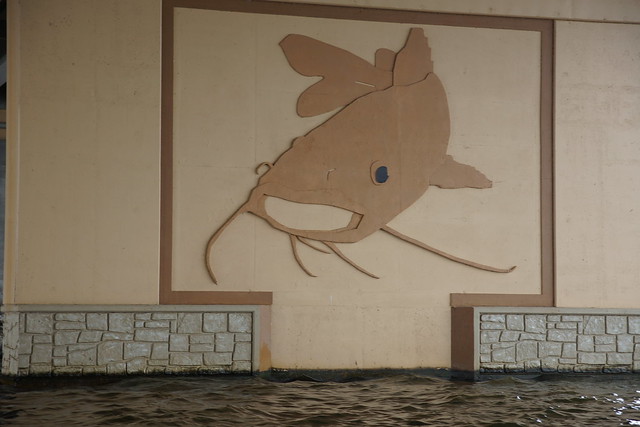
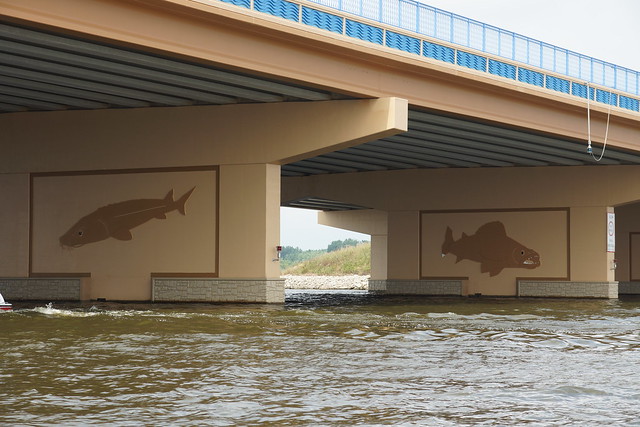
The former hwy 41 bridge over Lake Butte des Morts, just outside Oshkosh, was  one of those serviceable pieces of architecture like the communists built.  There has been a trend of late to make bridges more interesting without breaking the bank, and this was certainly achieved under the Butte des Morts bridge.  The addition of a foot bridge (not yet open) is also forward thinking, but I'm not sure it will get much use.  Also there is fishing access under the bridge another nice touch, but again I'm not sure how much use it will get.  One never knows, it may become an institution.
Walleye and lake sturgeon murals on the hwy 41 bridge, Oshkosh
Catfish mural

                           
Old hwy 41 bridge

Saturday, November 24, 2012

Finally a new post.

I've been writing for the Oshkosh Scene newspaper most of this year, my work blog, and I'm back in school, so I haven't been posting here much, but I'll start posting my Scene articles now.  The Oshkosh Scene can be found around Oshkosh for free most places, and it also available in a few newspaper machines. Here is my unedited article for November Issue.  The article was originally written for the Winnebago Water Level Fluctuation Group.


Generations of the Winnebago System

When the first pioneers settled around the Winnebago Pool Lakes in the middle of the nineteenth century, many made a living off the land and water.  Man and nature worked together, and also against one another.  The Fox River was “tamed” by dams, the prairie sod broken, but nature too had her floods and droughts to remind us who really is in charge.  In and around the Winnebago Pool Lakes much of the environment was degraded.  This environmental degradation changed the way people interacted with the land and water.   To understand how let’s follow a fictitious family through history. 

In 1841 a Norwegian man named Theodore Olson and his young wife Anna are settling on the north shore of Lake Poygan.  They have hastily erected a mud and stick house to keep the coming winter storms out.  In just two years time their first home will become the chicken coop, but for now it makes Theodore beam with pride, almost as much as the moose antlers above the door.  That big deer, the last one in the county, will feed this family through the winter. 

Monday, May 14, 2012

2012 Flood

High water over the last week and a half is talking its toll on both wildlife and habitat.  Those familiar with habitat on the Winnebago Upper Pool Lakes know that thousands of acres of marsh have been lost because of the break up of floating "bogs".  When water rises the intertangled roots that from a sort of sod rip from the underling soil and float.  During high winds or ice break up in spring these mats break off and float down and usually disintegrate in Lake Winnebago.  When there was more marsh hundreds of acres could be lost in one event.  Friday a steady wind developed and began ripping the marsh apart one small piece at a time.  I witnessed a dozen of these small mats floating within the break wall at Terrell's Island and coming out of the Fox River at Lake Butte des Morts.

Cattail mat
Floating cattail "bog", exiting Terrell's Island marsh.  

High water also plays havoc with birds nesting close to the water's surface.  During a nest count May 8th with the DNR I observed perhaps a hundred flooded pelican nests and a dozen or so drown chicks, and the water was still rising.  

Bird Colony
American White Pelican nesting in cattail marsh, now flooded.
Flooded eggs
Pelican nest in the process of being flooded.  Parents were
still attempting to incubate partially flooded nests.  

Wednesday, June 15, 2011

Common Terns - Endangered

Looking for Great Egrets - 120 nests on this island
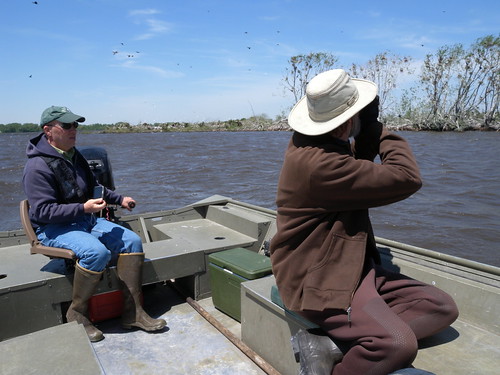
On June 1st, 2011 I assisted biologists Sumner Matteson and Art Techlow conduct bird surveys on Lake Winnebago and Lake Butte des Morts.  The Lake Winnebago survey had been postponed several times because of high winds.  High winds, Lake Winnebago and John boats are not a good mix.  Even this day we had strong winds were.  White caps were forming 50 yards from shore, but this time the direction was out of the west, and so the conditions were not too bad.  Today we were looking specifically for common terns, but also American white pelicans, great egrets and other birds.   
Common terns look similar to gulls, but they are smaller, have knife-shaped wings, and they’re most easily identified by the black caps on their heads.  If you see one of these birds, keep an eye on it.  Likely you’ll see it flying along and pause and hover in mid air.  Suddenly it will drop from the sky as if had a heart attack and plunge into the water.  A moment later it will reappear and head skyward, minnow in beak.  This minnow may be a snack, a gift for a mate, or food for its brood.   

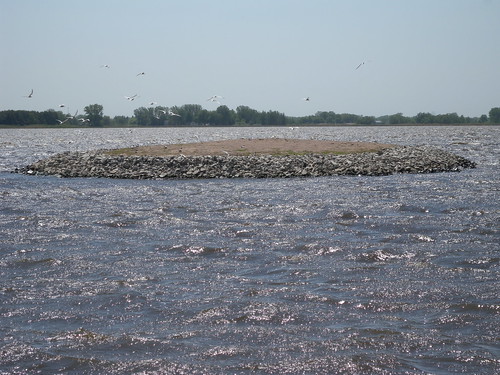
On Lake Winnebago there were no common terns nesting on an island where they had in previous years, because trees had grown up.  Common terns are not common in Wisconsin, in fact they are on the state’s endangered species list.  The main reason is they require nesting sites that are on beaches, or islands far from land predators.  They like a nice view of the horizon and if a site does not have one, they will not nest.  Common terns nest in colonies.  In Wisconsin there are only four, two on Lake Superior and two in Winnebago County.  This island on Lake Winnebago would have been the fifth.  The habitat of common terns has become increasingly scarce as beaches are developed and the sand bars of rivers disappear under reservoirs.  Because of this, the DNR and local partners have constructed two nesting islands, one in Lake Butte des Morts and the other in a large pond between Oshkosh and Winneconne.


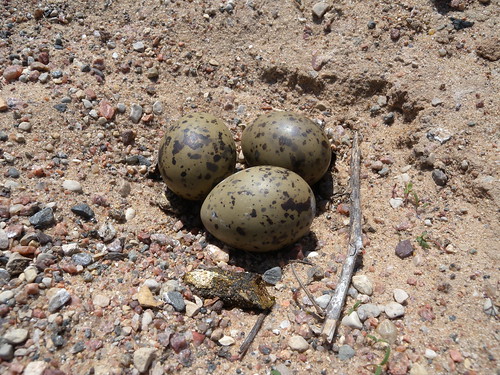
Common Tern Nest and Eggs
After checking Winnebago, the two DNR biologists and I brave the wind and waves of Lake Butte des Morts to check on the man-made island.  A few terns are in the air, and we can make out a few white dots on the island.  As we come, a small cloud of terns rises into the air simultaneously.  I hear a whoop out of a delighted Sumner, and look to Art who has a big grin.  This project works.  On the island I am careful not to crush the camouflaged eggs with my size 13 boots. We count 33 little scrapes in the sand with eggs.  This year it is Wisconsin’s entire breeding population south of Lake Superior, as the island in the pond has been abandoned this season.  Even though these islands are maintained for the terns, the small birds are still under threat from the big feet of pelicans and Canada geese, predatory gulls, and human disturbance.     
Common Tern Nesting Island
Note:  Please stay clear from these islands.  Too much human disturbance can cause the entire colony to abandon the site. 

The endangered Forster’s tern also nests on Lake Poygan, but unlike the common tern it nests on floating mats of vegetation.  The two species look very similar and are most easily differentiated by their calls.  High water and winds blew all the Lake Poygan birds’ nesting material away and they are not nesting here this season.  Much larger Caspian terns also visit the area, but do not breed. 

Sunday, May 15, 2011

Nest Count 2011

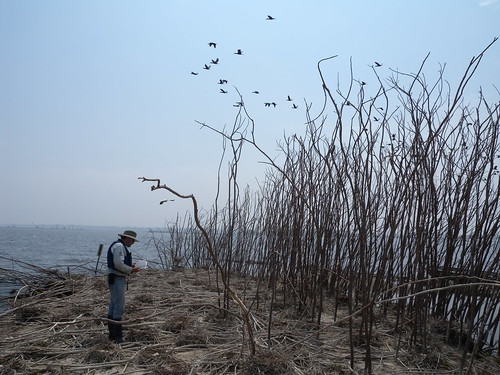
Sumner Mattson (WDNR) counts doiuble-crested cormorant nests,
while adults fly overhead.
I remember wildlife specials on TV from of Florida and other tropical places, where slender white birds with long plumes perched in flimsy nests.  There were strange looking black birds, and others had white long bills and yellow pouches they dipped in the water to scoop up fish.  Now those far places are here, they are on the islands of our lakes, and even within our cities.  It isn’t some new strange phenomenon, but the return of fish-eating birds after the banning of DDT and unregulated hunting.  Pelicans are experiencing a natural expansion of their range, and may have been present here pre-settlement.  These water birds are back and in some areas more numerous than they were 200 years ago, so it is a good idea to keep tabs on them.  With current staff there are too many sites to survey, but the Wisconsin Department of Natural Resources surveys some.  I helped with a survey on May 12, 2011 on Lake Butte des Morts.

American white pelican on Lake Butte des Morts,
Winnebago County nest made of gravel. 
The nesting colonies are truly fascinating places.  I saw all those “Florida birds” from TV:  white pelicans, double-crested cormorants, great egrets, black-crowned night herons, great-blue herons, and cattle egrets.  I walked among hundreds of nests, thousands of eggs, and was surrounded by birds taller than my seven year-old anxiously waiting for me to leave.  There is a certain awe being surrounded by so much life, so many eggs about to hatch, in such a foreign landscape.  However, most sane people would stay far from here.  Our nesting colonies are like those anywhere else that seabirds have nested for tens of millions of years, and there is much that makes all nesting colonies unpleasant.  American White Pelicans are very large and weigh about 16 lbs. and their big feet trample everything.  They even flatten cattails to make an area suitable for nesting.  Then there is the obvious:  a few thousand birds defecating in the same place day after day along with rotting fish and birds, producing an awful stench and polluting the surrounding water.  Many of these birds nest in trees, but eventually they produce so much nutrient-rich guano that they kill all the vegetation on these islands including the trees they nest in.   After spending several hours the fetid air began to make me weak and I could start to feel a burning sensation in my lungs. 

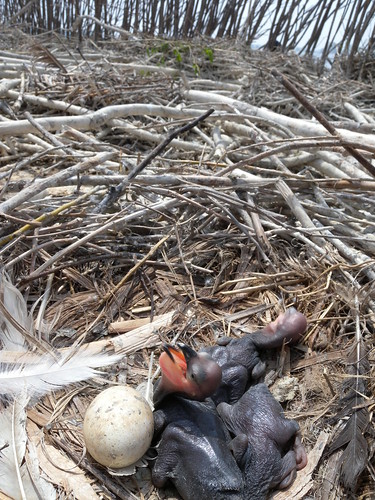
Cormorant chicks and eggs
It paints a nasty scene, both beautiful and revolting, but that’s nature.   Our lakes are as pretty as a postcard and the mosquitoes are as ruthless as the Russian mafia.  I don’t know how many cormorants or pelicans are too many, but it seems we have enough.  I don’t want too many of our islands, points and secluded areas to be polluted by species that congregate in numbers too many and produce so much pollution that they destroy their own habitat.  Species just like the one with the clipboard counting the nests. 


Nesting Colony
Subscribe to my YouTube Channel


Friday, May 6, 2011

No going back.


Fall Colors By Moonlight

I started this project in the winter, which can be a difficult time to come up with stunning landscape photos in flat marshes made more featureless with snow.  To get the project going on this blog and Flickr I searched through my archive of slides and digital photos.  One thing I realized was that there were many photos that I have taken over the years that I could not possibly retake in different light, or season.  Why?  Development has altered the landscape.  A house pops up here and there.  Some of the night photos I once took could no longer be done because of the spread of light pollution.  Although it seems I notice a new wrinkle every time I smile in the mirror, these photos are not old.  Most go back only ten to fifteen years.  I haven’t returned to these areas to photograph because sometimes it’s too aggravating or sad.

Slough Creek Sunrise

“Sunrise at Slough Creek” could not be taken again.  The barn is gone.  The big red barns are out dated for the modern farm, expensive to maintain and many are located at farms that are no longer operational.  So they fall much like the hay they used to store did to the sickle bar.  Behind where the barn used to be, two-lane Hwy 110 has been replaced by four lanes of Hwy 45 and 2 lanes of County Hwy S.  Highway 41 will soon loom even larger as construction of the 41/45 interchange continues.  The six lanes barely visible in the far horizon in 1998 will have turned into 12 in 2013.

Alfalfa No More

In the fields I used to frequent as a child there seems to have been some terrible mistake in crop rotation of corn, alfalfa, and soybeans.  Some crazy farmers have planted plastic beige and grey houses.  The first question every architect must ask a future home owner is what shade of beige or gray would you like your house to be.  No offense to those in beige houses--someone dropped my house and two dozen others on my street (most of them white and I’m sure made of old-growth white pine) in a farmer’s field a hundred years ago.  Same stuff different century.

Although not in one of our wetlands, this photo of a church is one of my favorites.  I’m about as religious as a moss covered rock, but I love the simple architecture of old rural churches.  This one sits all alone at the top of a hill.  I like the photo partially because it was taken in a -30 degree wind chill.  I guess I feel I earned it.  The spot where I took this photo is now home to an electrical substation.  I don’t think even a digital camera can photograph through a transformer. 
Development continues at a rapid pace.  When I surveyed plants and shorelines for the DNR in 2008 one marsh and two shorelines were destroyed within three months of my first visit.  So one of the things I’m trying to do with this project is to document changes in the landscape, natural and manmade.  When time and conditions allow I am using the GPS to geotag my photographs and get a compass heading.  Perhaps someone will come along years from now and wonder what’s changed, and be able to duplicate my photos.  Conservationists often use air photos to track changes in the landscape, but you can’t feel textures of hummocks dotting a sedge meadow from a satellite photo.  You can’t lament the loss of that meadow seen as a green spec from space that in a few years might break off as a floating mat and disintegrated in Lake Winnebago.  The same goes for the alfalfa field on a quiet foggy morning, or the wind playing with cattails in October.  
Country Church