Showing posts with label Birds. Show all posts

Monday, September 5, 2011

Summer is Winding Down

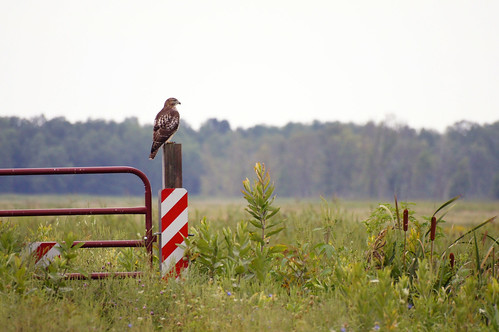
Red-tailed Hawk
I took a walk through Poygan State Wildlife Area yesterday morning.  A red-tailed hawk greeted me at the gate, and tolerated my presence probably because the hunting was good.  The sedges are beginning to change colors and many of the other plants have tinges of brown or yellow on the tips of their leaves.  Even though many are shutting down, a few are just getting started blooming.  The bumble bees seem less vigorous than they used to, these workers are burning out.  They have worked hard and none will survive the winter.  The water in the marsh's ditches is low, but filled with wood ducks, a few mallards and at least one blue-wing teal.  But there are some other interesting birds that catch my eye.
Wild Rice information

At first sight they look like birds that left the nest too soon.  They have the ungainly bodies of plucked chickens and flap their short wings in an almost hopeless flight.  These are not babies though, they are Sora--a little member of the rail family.  Like many rails, they are seldom seen.  They would rather run through the grass and sedge than take flight to escape danger.  Their flight muscles are weak, it is amazing that they will be able to migrate anywhere.  These sora are most abundant among the wild rice stems where I flush one and hear perhaps a dozen others, some only 15 feet away.  They look more like chickens than anything else, and love the wild rice grains.  Soon these little guys will be flapping those unlikely wings across the US Gulf Coast all the way to the Northern coast of South America.  Good luck guy, I'll see you--no, hear you--next year.

Sunday, May 15, 2011

Nest Count 2011

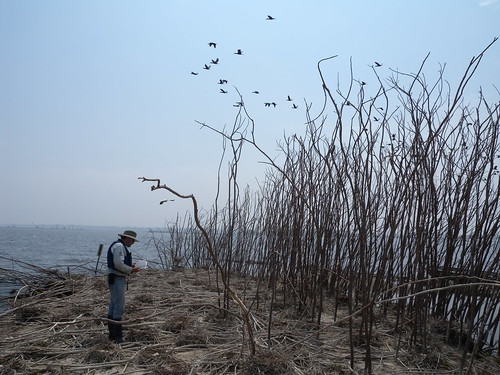
Sumner Mattson (WDNR) counts doiuble-crested cormorant nests,
while adults fly overhead.
I remember wildlife specials on TV from of Florida and other tropical places, where slender white birds with long plumes perched in flimsy nests.  There were strange looking black birds, and others had white long bills and yellow pouches they dipped in the water to scoop up fish.  Now those far places are here, they are on the islands of our lakes, and even within our cities.  It isn’t some new strange phenomenon, but the return of fish-eating birds after the banning of DDT and unregulated hunting.  Pelicans are experiencing a natural expansion of their range, and may have been present here pre-settlement.  These water birds are back and in some areas more numerous than they were 200 years ago, so it is a good idea to keep tabs on them.  With current staff there are too many sites to survey, but the Wisconsin Department of Natural Resources surveys some.  I helped with a survey on May 12, 2011 on Lake Butte des Morts.

American white pelican on Lake Butte des Morts,
Winnebago County nest made of gravel. 
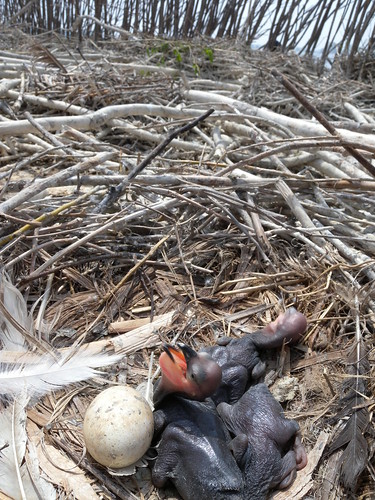
The nesting colonies are truly fascinating places.  I saw all those “Florida birds” from TV:  white pelicans, double-crested cormorants, great egrets, black-crowned night herons, great-blue herons, and cattle egrets.  I walked among hundreds of nests, thousands of eggs, and was surrounded by birds taller than my seven year-old anxiously waiting for me to leave.  There is a certain awe being surrounded by so much life, so many eggs about to hatch, in such a foreign landscape.  However, most sane people would stay far from here.  Our nesting colonies are like those anywhere else that seabirds have nested for tens of millions of years, and there is much that makes all nesting colonies unpleasant.  American White Pelicans are very large and weigh about 16 lbs. and their big feet trample everything.  They even flatten cattails to make an area suitable for nesting.  Then there is the obvious:  a few thousand birds defecating in the same place day after day along with rotting fish and birds, producing an awful stench and polluting the surrounding water.  Many of these birds nest in trees, but eventually they produce so much nutrient-rich guano that they kill all the vegetation on these islands including the trees they nest in.   After spending several hours the fetid air began to make me weak and I could start to feel a burning sensation in my lungs. 

Cormorant chicks and eggs
It paints a nasty scene, both beautiful and revolting, but that’s nature.   Our lakes are as pretty as a postcard and the mosquitoes are as ruthless as the Russian mafia.  I don’t know how many cormorants or pelicans are too many, but it seems we have enough.  I don’t want too many of our islands, points and secluded areas to be polluted by species that congregate in numbers too many and produce so much pollution that they destroy their own habitat.  Species just like the one with the clipboard counting the nests. 


Nesting Colony
Subscribe to my YouTube Channel


Saturday, April 23, 2011

Spring Update 3: Everybody Hates Me

At the parking lot today (4/21/2011) there is a flock of tree swallows darting about low over the gravel, picking bugs out of the air and the ground.  They pay me little attention, but other things have changed in the marsh since my last visit.  There are still many migrants stopping over on their journey north, but there are also many animals that have set up firm territories where I am an unwelcome guest.  I spend my time in the marsh walking the dredge bank along a long narrow ditch.  It is not like a lake or pond where disturbed waterfowl can just swim away and maintain a comfortable distance.  As I walk I drive the animals forward until they have no place to go. 

Lethargic Wood Chuck
As I walk and listen to the calling leopard frogs I flush a mallard hen who I’m sure is sitting on a nest.  I look for the nest for a minute and am unable to find it.  While I walk I am also pushing a pair of mallards in front of me, until they finally take flight.  They circle and quack at me, and shortly they are joined by a Canada goose who circles and honks.  Up ahead are a half dozen blue-wing teal.  They are much quieter, but as I push them to where they can no longer swim they begin to peep-whistle to each other excitedly while spinning around in circles.  Then one decides he’s had enough, erupts from the water, and the rest instantly join him.   The goose and mallards have returned to their territories, but another goose is in the ditch and begins to signal a warning to the others in the marsh.  A pair of sandhill cranes flying overhead does the same.  With all these warning calls I barely notice the shabby looking woodchuck six feet in front of me.  It stands there on its hind legs before walking away.  The poor guy looks gaunt after a long hibernation and I have no doubt I could have caught him with my bare hands. 

DON'T LOOK AT ME! - Canada goose on nest
This chasing of wildlife repeats itself over and over.  I notice three goose nests on muskrat lodges with their dutiful parent spread completely flat, looking like a teenage girl sitting as low as possible in the backseat of her dad’s car as she gets dropped off at the mall.  These nests are in easy range of any predator, and if I spot them, any fox, raccoon, or opossum will surely find them.  Geese don’t give up their nests easily, though, and any of these predators and opportunists will have a fight on their hands should they have a hankering for goose eggs.

Eventually the ditch and bank dead end and I turn back the way I came.  I meet the same woodchuck and all the other birds who exclaim the warning “there is a stranger in our midst.”  I meet someone new just before I get to my car, a mink swimming ahead of me as fast as it can before launching out of the water and scurrying into the safety of a burrow.  The tree swallows still swoop around me.  They appreciate my scaring the midges into taking flight, but everyone else hates me.

Friday, April 8, 2011

Spring Update #2

296 ducks over Poygan Marsh
I took a 3.5 mile walk at Poygan State Wildlife Area today (April 8, 2011).  Click on "read more" bellow to see a list of birds I saw.  All the birds were in, or flushed from the marsh, there were more passing overhead.

Thursday, March 24, 2011

Spring is still here.

Despite yesterday's terrible weather today is bright and sunny.  Robins were bouncing around in my driveway and the ducks did not head back south.  Go take a look at the ducks at the mouth of the Fox River in Oshkosh, there are hundreds of them.  I didn't bring my spotting scope, but from what I could see they were mainly scaup (bluebills) with some coots, mallards, cormorants, and Canada geese. I suppose it would have been nice to bring the camera and take some photos.

Monday, March 7, 2011

Owl's Impact

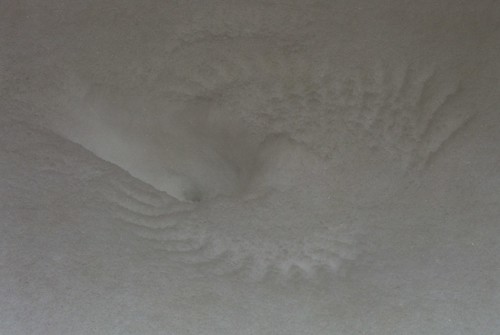
Imprint of an owl's wings.  Adjusted so feather marks can be seen.
In a swamp of the Rat River State Wildlife Area, in the silence of the night there is the soft muffle of wings landing on snow.  Deep in the snow crawls some furry little animal in its icy tunnel.  It hears the snow above penetrated by outstretched talons.  It runs down the tunnel to escape, but soon goes about its business searching for seeds and dormant insects.  It must keep its high metabolism fueled in this weather.  On top of the snow, the owl pauses and then rises from the snow in one mighty wing beat, and leaves with two talons full of snow.  In the snow it leaves the imprint of that one wing beat, and two little holes deep in the snow where the owl failed to get dinner.  I find them the next day while snowshoeing, proof of a little drama that plays out every night.
I imagine the little screech owl, or perhaps a saw-whet owl sitting in a silver maple above me, scanning the snow with his ears, listening for the pitter patter of tiny feet.   I’ve seen screech owls a few times before; one took up a winter residence in my mother-in-law’s wood duck house on the Yahara River.  It would peek out several times a day.  I heard screech owls in my Oshkosh backyard two weeks ago, and one, or the same one last fall.  They are there in the shadows of the night and sleeping the day away in the rotting silver maple in your front yard, perhaps as you read this.  The amazing scenes televised on PBS and Discovery Chanel shows play out every hour of every day in the swamp and even outside our urban homes.  Just look for the image frozen in snow.