Showing posts with label Sedge Meadow. Show all posts

Wednesday, December 26, 2012

Little Trappers


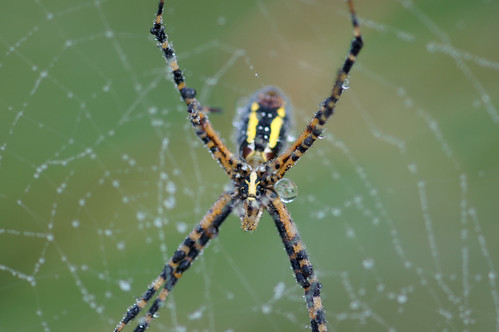
Spider Web
Orb Weaver Spider
The early morning light catches a dew speckled web in the marsh.  You can see such webs driving down the road, riding a bike, but it is best on foot.  You can observe the intricacies of the web, contemplate the mastery of the spinner with just a tiny speck for a brain, and never a teacher, or even a YouTube mentor to show it how it’s done.  Look close at the round globes of dew hanging from the web and notice the upside down, reversed and distorted world inside.  In a web you can read the story from the night before.  A hole in the web might indicate that some large insect, like a katydid crashed into the web tearing the silken threads.  You can find last night’s meal still stuck, or perhaps a snack all bundled up to be eaten later. 

If you are watching close to your feet as you walk, you’ll probably miss the web maker altogether, they will have dropped from view before you reach them.  Look ahead a little way as you walk and you’ll see them.  As you approach some will drop out of sight, but every now and then a slow approach and a cool morning the web spinner will stay dead center.   Some are small, and some are huge, at least by my standards.  These are some of the orb weaver spiders.  I could tell you some facts about orb weavers, but I must admit I’d have to go research them, and for me the orb weavers are like stars, they are for looking at in wonder.  I care not for the names of stars, what they are made of.  I may know some of those things, but when I look up at the sky it is a time to feel; to feel awe, to feel small and not to think.  When I look deep into the many eyes of the orb weavers I feel afraid, and feel it is time to move on.  Go search out the orb weavers if you dare.  You can find them in the marshes, prairies, and fields all around.  

Dew Web
Fly Eater


Previously published in the Oshkosh Scene.

Friday, September 2, 2011

Plant of the Week: Spotted Joe-Pye-Weed (Eupatorium maculatum)

Joe-Pye Weeds are among our most attractive wetland plants.  They bloom in late summer and fall,  adding a touch of color in an increasingly drab landscape.  The plant is said to be named after Joe-Pye a Native American Herbalist on the East Coast of the United States.

More about Spotted Joe-Pye Weed

Tuesday, July 26, 2011

A Little Trudge Through the Marsh

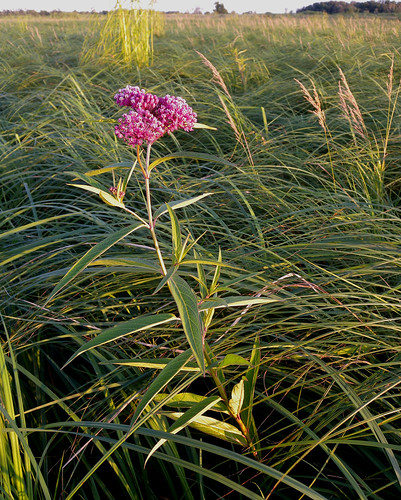
Marsh or Swamp Milkweed (Asclepias incarnata)

I have been staying away.  I've been there for quick visits many times this summer, but I’ve been away too long.  Before I step from the car the welcome committee arrives:  first deer flies swarm around the car, and then the mosquitoes land on the glass and prepare to pounce.  I take a deep breath, tuck my nose under my shirt and spray my arms and neck with OFF.  I step out of the car and gasp for air and rub a little of the insect repellent on my face.  The deer flies have formed a cyclone over my head.  I spray my hair.  I am now good and tacky and ready for adventure.  The deer flies land periodically, but take flight as soon as they touch down.  For the rest of this trudge my defenses will be constantly tested and the chinks in my armor found and exploited.  For now I can largely ignore the swarm of female insects that want to call me dinner. 

I strap on my backpack, weighed down with camera gear.  It is a movement of hope, much like buying a lottery ticket.  I don’t know if I’ll have a dry place to set it down when I’m out there, and so I don’t know if the 40 lbs is worth the effort.  I grab my walking stick for balance.  I head out and walk through a thick stand of reed canary-grass.  It is an invasive species and a plague on our wetlands.  I push back the tall grass to look and see if there are any species growing down there.  There are none.  Mosquito in my armpit, I push through another 100 feet and I’m in those grass-like sedges, a few grasses, flowers and shrubs.  This isn’t the diversity of the Amazon, but it is amazing in its own way and much better than the one species of grass just a few paces behind me.  If I should fall asleep for a year I would wake up surrounded by reed canary-grass as it advances and smothers this marsh.  I try to focus on the positive, sedges are at my feet and the sweet-smelling marsh milkweed is under my nose and a deer fly is up my sleeve.  Oh…positive thoughts.  There are short, fat, pale-green grasshoppers with comical expressions looking up from the sedges. 

Wool-grass (Scirpus cyprinus)
The sun is low on the horizon, there is no place to set down the camera bag, so I head west back to the car to maybe catch the sunset over there.  The return walk is like walking up rapids of a trout stream.  The prevailing winds have bent the sedges and grass toward me and now they provide stiff resistance.  Soon I the sweat beads on my face, the beads run together, and steady drip into and out of my eyes flow.  I huff and puff my way along, my back is soaked and the mosquitoes are watching the DEET drip off my body.  They rejoice when I take the back pack off and expose my unsprayed t-shirt, which they drill through immediately.  I set up the big camera and take some photos of the sun going down.  The sunset is pretty, but it doesn’t knock my socks off.  I turn around 180 degrees and see the cloud formations behind me are quite striking.  I set up and take their picture, pack up and drive home trough a rain of insects pelting the windshield.  As I approach Oshkosh, the fields and marshes have been decorated by thousands of flashing lightning bugs.  I pull off the road to listen to the tree frogs and watch the show.  There are no mosquitoes.  I think they are watching the show too.   

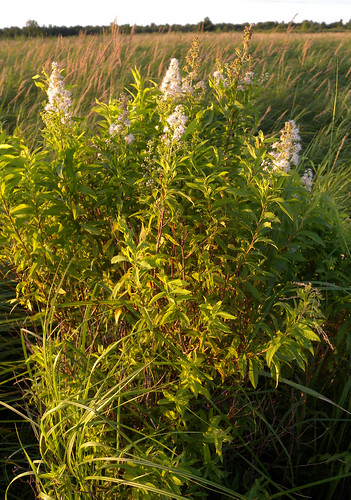
Plant of the Week: Meadowsweet (Spirea alb)


Meadowsweet looks similar to its close relative, steeple bush, which is often found in Wisconsin wetlands.  Other spirea species can be found in garden centers.

More on White Meadowsweet


Meadowsweet (Spirea alba)

Friday, April 8, 2011

Spring Update #2

296 ducks over Poygan Marsh
I took a 3.5 mile walk at Poygan State Wildlife Area today (April 8, 2011).  Click on "read more" bellow to see a list of birds I saw.  All the birds were in, or flushed from the marsh, there were more passing overhead.

Wednesday, April 6, 2011

Spring Update 1

Ash tree on stilts

Tuesday (4/5/2011) I took another little trip to the Poygan State Wildlife Area to check on the advancement of spring.  Again the morning was filled with the sounds of sandhill cranes, and many ducks and geese were flying, but not as many as a few weeks ago.  I walked along the ditches and waded a short distance into the swamp to take a picture of the flooded forest.  I set the tripod in the water and ice and headed back to high ground to grab my film and light meter.   I made my composition, tripped the shutter and headed back to dry ground.  Apparently for the whole ten minutes this took me, a barred owl was perched in a large silver maple directly above me.  I did not notice it until it silently flew off.

I continued to walk along the ditches of the wildlife area.  I saw my first frogs of the year, two leopard frogs basking in the early April sun. I saw another amphibian while heading across the sedge meadow; there was a small area of deeper water (14 inches) with a thin layer of ice on top surrounding a muskrat house.  As I broke through the ice with my big feet I frightened a tadpole under the ice and it swam away with surprising speed. 

Some of the birds along Black Hawk Road

Flooded farm fields make a good stop over for waterfowl
Tundra swan - 6
Pintail – 7
Mallard – 163
Blue-wing teal – 2
Green-wing teal – 2
Canada goose – 27
Wood duck – 2
Bald eagle – 1
Kingfisher – 1


Part of large school of carp
After that it was off to Waukau Creek to see if any fish were heading upstream to spawn, or in the case of carp, perhaps feed on eggs.  At the dam and pond there is an overflow channel that ends in a carp barrier.  At the base were a dozen northern pike on their spawning migration waiting for the right moment to try and make it over the barrier.  The biggest fish might have been 26 inches.  I walked the length of this channel and a little farther (750 ft) and counted 55 northern pike (1 every 14 ft), most of which my grandfather would have referred to as "gas pipes" (he was a master plumber).   Watching at the base of the carp barrier the water boiled and every few minutes I would see one of these little northern fight to make it upstream and get tossed back.  If the little guys are fast and lucky they might make it past the bars of the barrier, but I doubt any of the larger females will make it past to the lush spawning grounds of Rush Lake.  If you have the chance to check it out they may still be there for the next couple of days.  
Four northern pike bellow carp barrier at Waukau Creek

Thursday, March 17, 2011

It is all Happening so Fast (Part 1)

In my previous post I said I would try to update my readers on the rapid advance of spring.  Once again it is happening so fast, so here’s a quick update.  This morning I took a trip out to the marsh.  The parking lot I pull into was all aflutter with American robins those heralders of spring.  I actually arrived well in advance of the rising sun.  A quick scan of the overcast skies and the heavy breeze indicates I don’t need to bring all the heavy camera equipment, so I leave it in the car and traveled lightly.  Immediately  a pair of mallards buss me, and for the rest of the three hour trip every time I look up there are ducks, geese, and sandhill cranes. 

A blah day for for photography,
but a great one for wildlife watching
I take much the same route as I snowshoed in “Leaving a Trail” only 16 days earlier.  Today only a few snow drifts remain and the ditch I walked over 16 days ago is now open in parts.  Then, only a crow called out and the only other bird I saw was a northern harrier.  In today’s predawn I watch a group of 25 red-wing black birds rise from the cattails.  They are soon joined by another, then another flock from the same roust until several hundred birds are swirling in a living tornado over a ½ acre clump of cattails.  They rise and head west.  Most of the birds were heading west, including the little ducks (teal?) that are flying low and full throttle over me like a squadron of Messerschmitts intercepting B-17’s over Germany.  Spring is not a time for patience. 

As I walked the spoil bank there are the constant calls of cranes.  They spent the night in the marsh and are mustering the troops to head out to the fields to feed.  Eventually they depart, the constant honks of Canada geese replace them.  Some flocks numbered 30 or more, but many fly in pairs.  A pair of geese land in the frozen marsh within shotgun range, and pay me little attention.  No doubt they were deciding upon which of the many muskrat houses to build a nest.  Like the geese, there were a few stubborn pairs of sandhill cranes that give me a wide birth, but do not fly.  They too have claimed their territory.  They bow to each other and begin their strangely beautiful dance. 

Skunk Cabbage (Symplocarpus foetidus)
I plan to walk all the way to the lake today, 2 miles, but something stops me in my tracks.  It looks like a headless witch, perhaps a dragon flying over the marsh.  My eyes adjust, and my mind begins to decipher.  It is a bald eagle, its head nearly invisible in the overcast skies.  In its talons is a mass of long grass trailing three feet behind.  I watch it fly until it lands in its nest directly in my path.  My route is blocked, I turn back.  Along the ditch at the parking lot is our first flower:  skunk cabbage, in full bloom (more on that in a future post).  I get in the car with wet boots and pants.  

On the way home a mile outside of Oshkosh another bald eagle crosses Hwy 45 with a larger mass of grass.  Its flight is labored.  He works hard against the wind and clears some power lines by a couple of feet.  Catch a couple of walleyes for me, guys…I never can.    

Tuesday, March 1, 2011

Leaving a Trail

Snow Show Trail - Purchase Photo
I rise early to the cell phone belting out some little ringtone.  I head downstairs and do the usual things:  eat, let the dog out, check email, then I pack a snack, water, camera gear, and try to find my snowshoes among the garbage pile that is my garage.  Ah, there they are, right by the door.  My dog is very excited; she sees me lace my boots and thinks it’s time to go.  She looks at me as if I kicked her in the throat as I close the door, leaving her behind.  Sorry, I’ve got the camera bag, not the gun case this morning.  I’m greeting the sun today, or at least that is my intention when I start up the car later than I planned at 5:55.  I remind myself that come June I’ll have to be turning the key of my Honda at 3:00 am to greet the sun at my destination. The thought sends chills down my spine, the cold does not. 
I travel down the road without the aid of coffee.  I am alert, sort of.  Most traffic is leaving the countryside, heading off to work.  I’m headed to the marsh and I’m thankful.  As I ramble down County Hwy D, an owl flies low over the road.  I have never seen so many owls as I have since I started the project.  I’d better watch where am going.  Crap! Did I just drive through Borth?  I check the speedometer, then the rearview mirror:  no flashing lights.  Good.

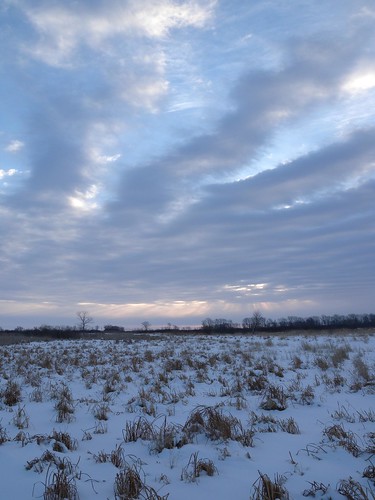
Snowy Sedge Meadow Sunrise

I arrive at Poygan State Wildlife Area at 6:32, sunrise was at 6:31 but there is no danger of missing anything today, the overcast skies have taken care of that.  Time to strap on my snowshoes.  They are wooden, bound together with rawhide.  They are out of date, just like the film camera in my backpack, unlike the digital camera around my neck and the GPS now turned on.  I take off over the marsh sedges, grasses, and flowers buried under snow, their empty seed pods and heads sticking out of the snow.  I try to recognize them:  blue-vervain, marsh milkweed, asters, mints, wool grass, tussock sedge, etc.  I see way too much reed canarygrass.  “Go away and stop consuming this sedge meadow!”   I cross one of the many drainage ditches.  For a time I follow another snowshoer’s trail.  This trail visits one rat house after another.  I guess it won’t be long before a bundle of Muskrat pelts are on their way to Russia, or maybe China.  The fur trade never ended.  
Mink Feet
The wind has kicked up.  I set up the big camera on its tripod.  The cold bites at my fingers and the metal camera sucks the heat from them.  Ten minutes later the picture is taken, I’ll see if it turns out in a month or so.   I turn around to see the clouds breaking up and snap a quick photo with the digital camera.  It will be the only camera I use for the rest of the day.  I trudge through the marsh for an hour, listening to ravens and the wind before taking the ridge of spoils (dredge material) along the drainage ditch.   All along and in the ditch were tracks from the night before alongside the tracks from many days ago.  Coyote tracks crisscrossed every which way while the tracks of mink and muskrat stay within several feet of the ditch.  I like mink.  Like many weasels they are curious and energetic.  They've often stopped to watch me as I stopped to watch them. I find a hole then several more where they entered the water.  Each hole is linked by the foot prints and belly slides of another weasel, the River Otter.  One otter trail breaks from the ditch to the bank where the otter slid repeatedly down the spoil bank for no other reason than fun.  There must be enough fish, frogs, etc. in this ditch to keep the otter fueled all winter.  I’m somewhat surprised.   
Then it’s back to the car.  At the car there is the smell of skunk in the air and their tracks on the ground.  I lower my backpack into the car, my back is relieved to have the pack off, and my stomach glad for a granola bar.  I take off my now sweaty jacket, scan the horizon one last time and head home.   

River otter trail: line moving from center to right.  Wildlife biologists use these distinctive trails to conduct otter population surveys from the air.