Showing posts with label Process. Show all posts

Friday, May 6, 2011

No going back.


Fall Colors By Moonlight

I started this project in the winter, which can be a difficult time to come up with stunning landscape photos in flat marshes made more featureless with snow.  To get the project going on this blog and Flickr I searched through my archive of slides and digital photos.  One thing I realized was that there were many photos that I have taken over the years that I could not possibly retake in different light, or season.  Why?  Development has altered the landscape.  A house pops up here and there.  Some of the night photos I once took could no longer be done because of the spread of light pollution.  Although it seems I notice a new wrinkle every time I smile in the mirror, these photos are not old.  Most go back only ten to fifteen years.  I haven’t returned to these areas to photograph because sometimes it’s too aggravating or sad.

Slough Creek Sunrise

“Sunrise at Slough Creek” could not be taken again.  The barn is gone.  The big red barns are out dated for the modern farm, expensive to maintain and many are located at farms that are no longer operational.  So they fall much like the hay they used to store did to the sickle bar.  Behind where the barn used to be, two-lane Hwy 110 has been replaced by four lanes of Hwy 45 and 2 lanes of County Hwy S.  Highway 41 will soon loom even larger as construction of the 41/45 interchange continues.  The six lanes barely visible in the far horizon in 1998 will have turned into 12 in 2013.

Alfalfa No More

In the fields I used to frequent as a child there seems to have been some terrible mistake in crop rotation of corn, alfalfa, and soybeans.  Some crazy farmers have planted plastic beige and grey houses.  The first question every architect must ask a future home owner is what shade of beige or gray would you like your house to be.  No offense to those in beige houses--someone dropped my house and two dozen others on my street (most of them white and I’m sure made of old-growth white pine) in a farmer’s field a hundred years ago.  Same stuff different century.

Although not in one of our wetlands, this photo of a church is one of my favorites.  I’m about as religious as a moss covered rock, but I love the simple architecture of old rural churches.  This one sits all alone at the top of a hill.  I like the photo partially because it was taken in a -30 degree wind chill.  I guess I feel I earned it.  The spot where I took this photo is now home to an electrical substation.  I don’t think even a digital camera can photograph through a transformer. 
Development continues at a rapid pace.  When I surveyed plants and shorelines for the DNR in 2008 one marsh and two shorelines were destroyed within three months of my first visit.  So one of the things I’m trying to do with this project is to document changes in the landscape, natural and manmade.  When time and conditions allow I am using the GPS to geotag my photographs and get a compass heading.  Perhaps someone will come along years from now and wonder what’s changed, and be able to duplicate my photos.  Conservationists often use air photos to track changes in the landscape, but you can’t feel textures of hummocks dotting a sedge meadow from a satellite photo.  You can’t lament the loss of that meadow seen as a green spec from space that in a few years might break off as a floating mat and disintegrated in Lake Winnebago.  The same goes for the alfalfa field on a quiet foggy morning, or the wind playing with cattails in October.  
Country Church

Thursday, March 17, 2011

It is all Happening so Fast (Part 1)

In my previous post I said I would try to update my readers on the rapid advance of spring.  Once again it is happening so fast, so here’s a quick update.  This morning I took a trip out to the marsh.  The parking lot I pull into was all aflutter with American robins those heralders of spring.  I actually arrived well in advance of the rising sun.  A quick scan of the overcast skies and the heavy breeze indicates I don’t need to bring all the heavy camera equipment, so I leave it in the car and traveled lightly.  Immediately  a pair of mallards buss me, and for the rest of the three hour trip every time I look up there are ducks, geese, and sandhill cranes. 

A blah day for for photography,
but a great one for wildlife watching
I take much the same route as I snowshoed in “Leaving a Trail” only 16 days earlier.  Today only a few snow drifts remain and the ditch I walked over 16 days ago is now open in parts.  Then, only a crow called out and the only other bird I saw was a northern harrier.  In today’s predawn I watch a group of 25 red-wing black birds rise from the cattails.  They are soon joined by another, then another flock from the same roust until several hundred birds are swirling in a living tornado over a ½ acre clump of cattails.  They rise and head west.  Most of the birds were heading west, including the little ducks (teal?) that are flying low and full throttle over me like a squadron of Messerschmitts intercepting B-17’s over Germany.  Spring is not a time for patience. 

As I walked the spoil bank there are the constant calls of cranes.  They spent the night in the marsh and are mustering the troops to head out to the fields to feed.  Eventually they depart, the constant honks of Canada geese replace them.  Some flocks numbered 30 or more, but many fly in pairs.  A pair of geese land in the frozen marsh within shotgun range, and pay me little attention.  No doubt they were deciding upon which of the many muskrat houses to build a nest.  Like the geese, there were a few stubborn pairs of sandhill cranes that give me a wide birth, but do not fly.  They too have claimed their territory.  They bow to each other and begin their strangely beautiful dance. 

Skunk Cabbage (Symplocarpus foetidus)
I plan to walk all the way to the lake today, 2 miles, but something stops me in my tracks.  It looks like a headless witch, perhaps a dragon flying over the marsh.  My eyes adjust, and my mind begins to decipher.  It is a bald eagle, its head nearly invisible in the overcast skies.  In its talons is a mass of long grass trailing three feet behind.  I watch it fly until it lands in its nest directly in my path.  My route is blocked, I turn back.  Along the ditch at the parking lot is our first flower:  skunk cabbage, in full bloom (more on that in a future post).  I get in the car with wet boots and pants.  

On the way home a mile outside of Oshkosh another bald eagle crosses Hwy 45 with a larger mass of grass.  Its flight is labored.  He works hard against the wind and clears some power lines by a couple of feet.  Catch a couple of walleyes for me, guys…I never can.    

Sunday, March 6, 2011

For All You Camera and Photo Buffs

I've gone through most of the photos on Flickr from my archives and added camera, lens and film data if I can remember it.  For my old 35mm slides I'd have to tear through the cardboard or plastic to confirm what type of film I used, so I won't do that.  However it is safe to say they are probably all shot on Fuji Velvia 50 (RVP) transparency film.  I shot hundreds of rolls of it because of its sharpness and color saturation.  They still make it.  I shot mostly with Nikon film cameras in the past; N50, N6006, N80 and a variety of Nikon, Sigma and Tamron lenses.  I will make an effort to add the technical data from future photos.  Photos taken with digital cameras have all that encoded in the files and are available by clicking on the name of the camera in the upper right.  For scanning I'm primarily using a Epson V750 with very good results. 

Tuesday, March 1, 2011

Leaving a Trail

Snow Show Trail - Purchase Photo
I rise early to the cell phone belting out some little ringtone.  I head downstairs and do the usual things:  eat, let the dog out, check email, then I pack a snack, water, camera gear, and try to find my snowshoes among the garbage pile that is my garage.  Ah, there they are, right by the door.  My dog is very excited; she sees me lace my boots and thinks it’s time to go.  She looks at me as if I kicked her in the throat as I close the door, leaving her behind.  Sorry, I’ve got the camera bag, not the gun case this morning.  I’m greeting the sun today, or at least that is my intention when I start up the car later than I planned at 5:55.  I remind myself that come June I’ll have to be turning the key of my Honda at 3:00 am to greet the sun at my destination. The thought sends chills down my spine, the cold does not. 
I travel down the road without the aid of coffee.  I am alert, sort of.  Most traffic is leaving the countryside, heading off to work.  I’m headed to the marsh and I’m thankful.  As I ramble down County Hwy D, an owl flies low over the road.  I have never seen so many owls as I have since I started the project.  I’d better watch where am going.  Crap! Did I just drive through Borth?  I check the speedometer, then the rearview mirror:  no flashing lights.  Good.

Snowy Sedge Meadow Sunrise

I arrive at Poygan State Wildlife Area at 6:32, sunrise was at 6:31 but there is no danger of missing anything today, the overcast skies have taken care of that.  Time to strap on my snowshoes.  They are wooden, bound together with rawhide.  They are out of date, just like the film camera in my backpack, unlike the digital camera around my neck and the GPS now turned on.  I take off over the marsh sedges, grasses, and flowers buried under snow, their empty seed pods and heads sticking out of the snow.  I try to recognize them:  blue-vervain, marsh milkweed, asters, mints, wool grass, tussock sedge, etc.  I see way too much reed canarygrass.  “Go away and stop consuming this sedge meadow!”   I cross one of the many drainage ditches.  For a time I follow another snowshoer’s trail.  This trail visits one rat house after another.  I guess it won’t be long before a bundle of Muskrat pelts are on their way to Russia, or maybe China.  The fur trade never ended.  
Mink Feet
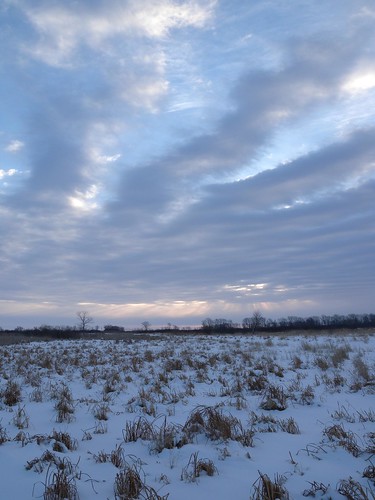
The wind has kicked up.  I set up the big camera on its tripod.  The cold bites at my fingers and the metal camera sucks the heat from them.  Ten minutes later the picture is taken, I’ll see if it turns out in a month or so.   I turn around to see the clouds breaking up and snap a quick photo with the digital camera.  It will be the only camera I use for the rest of the day.  I trudge through the marsh for an hour, listening to ravens and the wind before taking the ridge of spoils (dredge material) along the drainage ditch.   All along and in the ditch were tracks from the night before alongside the tracks from many days ago.  Coyote tracks crisscrossed every which way while the tracks of mink and muskrat stay within several feet of the ditch.  I like mink.  Like many weasels they are curious and energetic.  They've often stopped to watch me as I stopped to watch them. I find a hole then several more where they entered the water.  Each hole is linked by the foot prints and belly slides of another weasel, the River Otter.  One otter trail breaks from the ditch to the bank where the otter slid repeatedly down the spoil bank for no other reason than fun.  There must be enough fish, frogs, etc. in this ditch to keep the otter fueled all winter.  I’m somewhat surprised.   
Then it’s back to the car.  At the car there is the smell of skunk in the air and their tracks on the ground.  I lower my backpack into the car, my back is relieved to have the pack off, and my stomach glad for a granola bar.  I take off my now sweaty jacket, scan the horizon one last time and head home.   

River otter trail: line moving from center to right.  Wildlife biologists use these distinctive trails to conduct otter population surveys from the air.