Showing posts with label Wildlife. Show all posts
Showing posts with label Wildlife. Show all posts
Wednesday, November 13, 2013
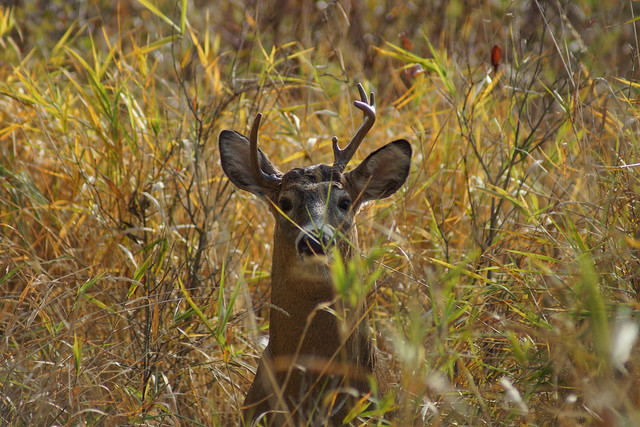
Swamp White-tail
This white-tailed deer came to see what was making the rustling noise in the leaves. I could just make it out as it left the safety to dogwood, walked through the tall grasses, and finally poked its head up to take a look at me. It was probably only a trip of 100 feet, but it made me feel like I was an import curiosity for this buck. For a change I had a telephoto lens on the camera because I had been chasing a white-breasted nuthatch. I was unable to get a nice photo of him, but got this nice portrait of the deer.


Monday, September 5, 2011
Summer is Winding Down
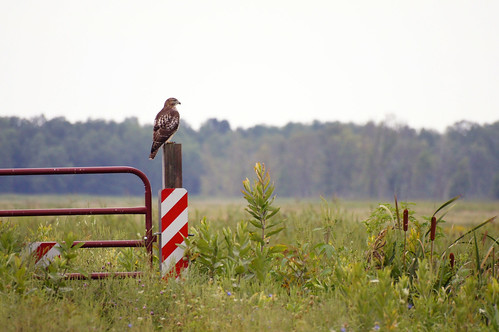 |
| Red-tailed Hawk |
 |
| Wild Rice information |
At first sight they look like birds that left the nest too soon. They have the ungainly bodies of plucked chickens and flap their short wings in an almost hopeless flight. These are not babies though, they are Sora--a little member of the rail family. Like many rails, they are seldom seen. They would rather run through the grass and sedge than take flight to escape danger. Their flight muscles are weak, it is amazing that they will be able to migrate anywhere. These sora are most abundant among the wild rice stems where I flush one and hear perhaps a dozen others, some only 15 feet away. They look more like chickens than anything else, and love the wild rice grains. Soon these little guys will be flapping those unlikely wings across the US Gulf Coast all the way to the Northern coast of South America. Good luck guy, I'll see you--no, hear you--next year.
Sunday, May 15, 2011
Nest Count 2011
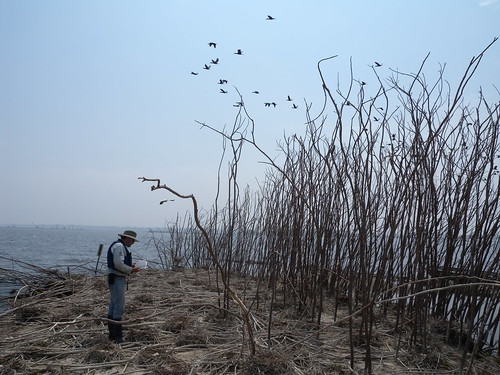 |
| Sumner Mattson (WDNR) counts doiuble-crested cormorant nests, while adults fly overhead. |
I remember wildlife specials on TV from of Florida and other tropical places, where slender white birds with long plumes perched in flimsy nests. There were strange looking black birds, and others had white long bills and yellow pouches they dipped in the water to scoop up fish. Now those far places are here, they are on the islands of our lakes, and even within our cities. It isn’t some new strange phenomenon, but the return of fish-eating birds after the banning of DDT and unregulated hunting. Pelicans are experiencing a natural expansion of their range, and may have been present here pre-settlement. These water birds are back and in some areas more numerous than they were 200 years ago, so it is a good idea to keep tabs on them. With current staff there are too many sites to survey, but the Wisconsin Department of Natural Resources surveys some. I helped with a survey on May 12, 2011 on Lake Butte des Morts.
 |
| American white pelican on Lake Butte des Morts, Winnebago County nest made of gravel. |
The nesting colonies are truly fascinating places. I saw all those “Florida birds” from TV: white pelicans, double-crested cormorants, great egrets, black-crowned night herons, great-blue herons, and cattle egrets. I walked among hundreds of nests, thousands of eggs, and was surrounded by birds taller than my seven year-old anxiously waiting for me to leave. There is a certain awe being surrounded by so much life, so many eggs about to hatch, in such a foreign landscape. However, most sane people would stay far from here. Our nesting colonies are like those anywhere else that seabirds have nested for tens of millions of years, and there is much that makes all nesting colonies unpleasant. American White Pelicans are very large and weigh about 16 lbs. and their big feet trample everything. They even flatten cattails to make an area suitable for nesting. Then there is the obvious: a few thousand birds defecating in the same place day after day along with rotting fish and birds, producing an awful stench and polluting the surrounding water. Many of these birds nest in trees, but eventually they produce so much nutrient-rich guano that they kill all the vegetation on these islands including the trees they nest in. After spending several hours the fetid air began to make me weak and I could start to feel a burning sensation in my lungs.
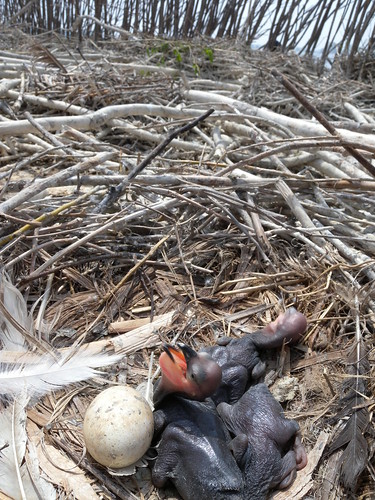 |
| Cormorant chicks and eggs |
It paints a nasty scene, both beautiful and revolting, but that’s nature. Our lakes are as pretty as a postcard and the mosquitoes are as ruthless as the Russian mafia. I don’t know how many cormorants or pelicans are too many, but it seems we have enough. I don’t want too many of our islands, points and secluded areas to be polluted by species that congregate in numbers too many and produce so much pollution that they destroy their own habitat. Species just like the one with the clipboard counting the nests.
Nesting Colony
Subscribe to my YouTube Channel
Saturday, April 23, 2011
Spring Update 3: Everybody Hates Me
At the parking lot today (4/21/2011) there is a flock of tree swallows darting about low over the gravel, picking bugs out of the air and the ground. They pay me little attention, but other things have changed in the marsh since my last visit. There are still many migrants stopping over on their journey north, but there are also many animals that have set up firm territories where I am an unwelcome guest. I spend my time in the marsh walking the dredge bank along a long narrow ditch. It is not like a lake or pond where disturbed waterfowl can just swim away and maintain a comfortable distance. As I walk I drive the animals forward until they have no place to go.
 |
| Lethargic Wood Chuck |
As I walk and listen to the calling leopard frogs I flush a mallard hen who I’m sure is sitting on a nest. I look for the nest for a minute and am unable to find it. While I walk I am also pushing a pair of mallards in front of me, until they finally take flight. They circle and quack at me, and shortly they are joined by a Canada goose who circles and honks. Up ahead are a half dozen blue-wing teal. They are much quieter, but as I push them to where they can no longer swim they begin to peep-whistle to each other excitedly while spinning around in circles. Then one decides he’s had enough, erupts from the water, and the rest instantly join him. The goose and mallards have returned to their territories, but another goose is in the ditch and begins to signal a warning to the others in the marsh. A pair of sandhill cranes flying overhead does the same. With all these warning calls I barely notice the shabby looking woodchuck six feet in front of me. It stands there on its hind legs before walking away. The poor guy looks gaunt after a long hibernation and I have no doubt I could have caught him with my bare hands.
 |
| DON'T LOOK AT ME! - Canada goose on nest |
This chasing of wildlife repeats itself over and over. I notice three goose nests on muskrat lodges with their dutiful parent spread completely flat, looking like a teenage girl sitting as low as possible in the backseat of her dad’s car as she gets dropped off at the mall. These nests are in easy range of any predator, and if I spot them, any fox, raccoon, or opossum will surely find them. Geese don’t give up their nests easily, though, and any of these predators and opportunists will have a fight on their hands should they have a hankering for goose eggs.
Eventually the ditch and bank dead end and I turn back the way I came. I meet the same woodchuck and all the other birds who exclaim the warning “there is a stranger in our midst.” I meet someone new just before I get to my car, a mink swimming ahead of me as fast as it can before launching out of the water and scurrying into the safety of a burrow. The tree swallows still swoop around me. They appreciate my scaring the midges into taking flight, but everyone else hates me.
Tuesday, April 12, 2011
A Terrible Time for Muskrats
This is the time of year when young muskrats (Ondatra zibethica) get pushed out of their parents’ houses and are forced to look for their own territory. The poor near-sighted guys strike out on their own, leaving the marshes, ponds and lakes of their birth behind. Unfortunately as they travel far and wide they don’t go unnoticed by red-tailed hawks and coyotes, but perhaps their greatest enemy is rubber. One day on my way from Oshkosh to Green Bay I counted 18 flattened brown fur balls on just one side of the highway. So if you happen to see a fat brown mammal with a naked tail running through your yard, have no fear, it’s just a muskrat looking for a new home, and a little love.
I thought I’d spare you a photo of muskrat hamburger todayJ
Friday, April 8, 2011
Spring Update #2
 |
| 296 ducks over Poygan Marsh |
Wednesday, April 6, 2011
Spring Update 1
 |
| Ash tree on stilts |
Tuesday (4/5/2011) I took another little trip to the Poygan State Wildlife Area to check on the advancement of spring. Again the morning was filled with the sounds of sandhill cranes, and many ducks and geese were flying, but not as many as a few weeks ago. I walked along the ditches and waded a short distance into the swamp to take a picture of the flooded forest. I set the tripod in the water and ice and headed back to high ground to grab my film and light meter. I made my composition, tripped the shutter and headed back to dry ground. Apparently for the whole ten minutes this took me, a barred owl was perched in a large silver maple directly above me. I did not notice it until it silently flew off.
I continued to walk along the ditches of the wildlife area. I saw my first frogs of the year, two leopard frogs basking in the early April sun. I saw another amphibian while heading across the sedge meadow; there was a small area of deeper water (14 inches) with a thin layer of ice on top surrounding a muskrat house. As I broke through the ice with my big feet I frightened a tadpole under the ice and it swam away with surprising speed.
Some of the birds along Black Hawk Road
 |
| Flooded farm fields make a good stop over for waterfowl |
Tundra swan - 6
Pintail – 7
Mallard – 163
Blue-wing teal – 2
Green-wing teal – 2
Canada goose – 27
Wood duck – 2
Bald eagle – 1
Kingfisher – 1
 |
| Part of large school of carp |
 |
| Four northern pike bellow carp barrier at Waukau Creek |
Tuesday, March 29, 2011
Waiting for Frogs
 |
An American toad, the gardeners’ friend. |
I’ve always liked frogs and toads. They are completely unique creatures. Salamanders look like lizards, fish look like whales, but nothing looks like a frog except a frog. Even though populations of frogs are in retreat, they are found almost everywhere. They are a challenge to catch with bare hands because they are slippery and fast. I can’t count how many hours I have spent searching and catching frogs, both as a kid and an adult, but it was always time well spent.
 |
A full grown spring peeper, in the pretty hands of my proofreader. |
Last week Mother Nature cruelly reminded us who is in charge as she always does this time of year by dumping ice and snow on us followed by an unusual cold snap that is barely breaking today. Naturally, I’m thinking of frogs. Our local frogs are still in hiding, but not for much longer. Northern leopard frogs are lying on the bottom of the lake, wedged in boulders, and hiding under turtles. Soon they’ll come out of hiding and start looking for love. Wood frogs, spring peepers, chorus frogs, and tree frogs are toughing it out; they don’t hide below the frost line. They are content to have much of their bodies literally turn to ice. Soon they’ll thaw out and the wood frogs will be croaking, the spring peepers peeping, and the wester chorus frogs chorusing before all the ice has left the ponds. They’ll quickly breed and then head into the woods and fields for the rest of the warm months.
 |
The last thing many tadpoles see; a giant water bug. They eat fish, insects, tadpoles, frogs and have even been known to attack ducklings. This one flew into the patio doors of my parents’ house and resides my collection. It measures 2 3/16 inches. |
When most frogs’ eggs hatch there is a race to metamorphose into their jumping forms as quickly as possible, but the tadpoles of our largest frogs--the bullfrog and the green frog-- are swimming under the ice munching algae and doing their best to avoid capture by giant water bugs and many other predators. They take two frightening seasons to transform into frogs.
 |
For American Toads tadpoles it is a race to transform into a toad. These were found living in and on the shoulder of a gravel road in the Nicolet National Forest! |
Frogs and Toads of the Winnebago Pool and Wetlands:
American Toad (Bufo americanus)
Cope' Gray Treefrog (Hyla chrysoscelis)
Eastern Gray Treefrog (Hyla versicolor)
Spring Peeper (Pseudacris crucifer)
Western Chorus Frog (Pseudacris triseriata)
Bull Frog (Rana catesbeiana)
Green Frog (Rana clamitans)
Pickerel Frog (Rana palustris)
Northern Leopard Frog (Rana pipiens)
Wood Frog (Rana sylvatica)
Thursday, March 17, 2011
It is all Happening so Fast (Part 1)
In my previous post I said I would try to update my readers on the rapid advance of spring. Once again it is happening so fast, so here’s a quick update. This morning I took a trip out to the marsh. The parking lot I pull into was all aflutter with American robins those heralders of spring. I actually arrived well in advance of the rising sun. A quick scan of the overcast skies and the heavy breeze indicates I don’t need to bring all the heavy camera equipment, so I leave it in the car and traveled lightly. Immediately a pair of mallards buss me, and for the rest of the three hour trip every time I look up there are ducks, geese, and sandhill cranes.
 |
| A blah day for for photography, but a great one for wildlife watching |
I take much the same route as I snowshoed in “Leaving a Trail” only 16 days earlier. Today only a few snow drifts remain and the ditch I walked over 16 days ago is now open in parts. Then, only a crow called out and the only other bird I saw was a northern harrier. In today’s predawn I watch a group of 25 red-wing black birds rise from the cattails. They are soon joined by another, then another flock from the same roust until several hundred birds are swirling in a living tornado over a ½ acre clump of cattails. They rise and head west. Most of the birds were heading west, including the little ducks (teal?) that are flying low and full throttle over me like a squadron of Messerschmitts intercepting B-17’s over Germany. Spring is not a time for patience.
As I walked the spoil bank there are the constant calls of cranes. They spent the night in the marsh and are mustering the troops to head out to the fields to feed. Eventually they depart, the constant honks of Canada geese replace them. Some flocks numbered 30 or more, but many fly in pairs. A pair of geese land in the frozen marsh within shotgun range, and pay me little attention. No doubt they were deciding upon which of the many muskrat houses to build a nest. Like the geese, there were a few stubborn pairs of sandhill cranes that give me a wide birth, but do not fly. They too have claimed their territory. They bow to each other and begin their strangely beautiful dance.
 |
| Skunk Cabbage (Symplocarpus foetidus) |
I plan to walk all the way to the lake today, 2 miles, but something stops me in my tracks. It looks like a headless witch, perhaps a dragon flying over the marsh. My eyes adjust, and my mind begins to decipher. It is a bald eagle, its head nearly invisible in the overcast skies. In its talons is a mass of long grass trailing three feet behind. I watch it fly until it lands in its nest directly in my path. My route is blocked, I turn back. Along the ditch at the parking lot is our first flower: skunk cabbage, in full bloom (more on that in a future post). I get in the car with wet boots and pants.
On the way home a mile outside of Oshkosh another bald eagle crosses Hwy 45 with a larger mass of grass. Its flight is labored. He works hard against the wind and clears some power lines by a couple of feet. Catch a couple of walleyes for me, guys…I never can.
Sunday, March 13, 2011
“It all happened so fast”
I find myself saying this each spring and think I will catch more of it next year. Spring is a time when everything happens at once in the natural world. By comparison, summer is a lazy time; fall is sleepy and winter, comatose. The stage is already set in early March for the coming two months. By the time the ice melts, the cold lakes and brown wetlands are in high gear. As I type this, many of the mammals we know are pregnant, and some are even giving birth under the snow. Otters, for instance have been pregnant for 9 to perhaps 12 months, and may already be nursing their young. Otters and other weasels have delayed implantation; the fertilized egg is in suspended animation for months. If otters had a three month prenatal visit the doctor would say something like “Mrs. Otter, everything is just fine. Your babies aren’t growing at all.”
 |
| Canvasbacks and other ducks on Lake Winnebago, Oshkosh, Wisconsin March 31, 2009 |
The birds are getting anxious. The migrants are starting to return, the redwing blackbirds are back and the sandhill cranes too, and a dozen others will soon follow. Diving ducks will congregate in the first patches of open water on Lake Winnebago. Some birds are staking out nesting territories, but great-horned owls are already sitting on eggs in mid-March. No doubt in our swamps there was a snow-covered owl earlier this week protecting her eggs from the cold. In my own backyard the crows have reclaimed last year’s nest, but probably won’t lay for several more weeks.
Even more is happening under the ice. Lake sturgeon are swimming up the Fox and Wolf Rivers to prepare for their spawning runs. Walleye will soon abandon Lake Winnebago for their ancestral marshes of the Fox and Wolf Rivers. A lazy and unique population of walleye will stay behind and spawn on the rocks and cobble of Lake Winnebago. It is the northern pike which are most ready to get underway. The moment the ice goes out they will be cruising flooded marshes and emergent vegetation within the lakes to spawn. They must attach their eggs to vertical vegetation. Without our marshes, there would not be a good walleye or northern fishery. Yellow perch will also lay their eggs as soon as the ice goes out. All this happens before the fair weather fisherman even contemplates drowning a worm.
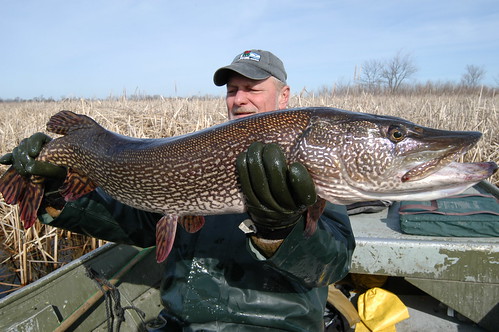 |
| Bob Olynyk of the WI DNR with a female Northern Pike caught via fyke net as part of 2009 population survey. Yes, I used a wide angle lens technique to exagerate size, like any good fish magazine photographer. This was a good fish however at 38 1/2 inches. |
This year I will once again make an attempt to get out more, see more, hear more and photograph more. I’ll do my best to keep you informed through this blog, and facebook, so that you might be able to get out and see some of these events too. No matter how well I do this spring, there is no doubt that sometime in May I’ll be muttering “It all happened so fast” in my sleep.
Monday, March 7, 2011
Owl's Impact
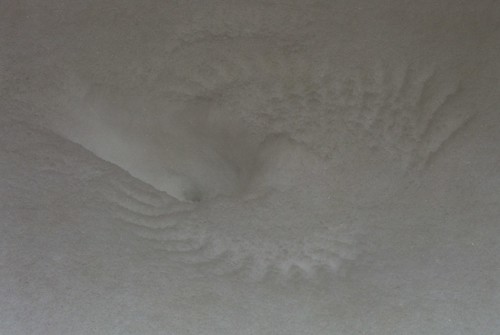 |
| Imprint of an owl's wings. Adjusted so feather marks can be seen. |
In a swamp of the Rat River State Wildlife Area, in the silence of the night there is the soft muffle of wings landing on snow. Deep in the snow crawls some furry little animal in its icy tunnel. It hears the snow above penetrated by outstretched talons. It runs down the tunnel to escape, but soon goes about its business searching for seeds and dormant insects. It must keep its high metabolism fueled in this weather. On top of the snow, the owl pauses and then rises from the snow in one mighty wing beat, and leaves with two talons full of snow. In the snow it leaves the imprint of that one wing beat, and two little holes deep in the snow where the owl failed to get dinner. I find them the next day while snowshoeing, proof of a little drama that plays out every night.
I imagine the little screech owl, or perhaps a saw-whet owl sitting in a silver maple above me, scanning the snow with his ears, listening for the pitter patter of tiny feet. I’ve seen screech owls a few times before; one took up a winter residence in my mother-in-law’s wood duck house on the Yahara River. It would peek out several times a day. I heard screech owls in my Oshkosh backyard two weeks ago, and one, or the same one last fall. They are there in the shadows of the night and sleeping the day away in the rotting silver maple in your front yard, perhaps as you read this. The amazing scenes televised on PBS and Discovery Chanel shows play out every hour of every day in the swamp and even outside our urban homes. Just look for the image frozen in snow.
Tuesday, March 1, 2011
Leaving a Trail
 |
| Snow Show Trail - Purchase Photo |
I rise early to the cell phone belting out some little ringtone. I head downstairs and do the usual things: eat, let the dog out, check email, then I pack a snack, water, camera gear, and try to find my snowshoes among the garbage pile that is my garage. Ah, there they are, right by the door. My dog is very excited; she sees me lace my boots and thinks it’s time to go. She looks at me as if I kicked her in the throat as I close the door, leaving her behind. Sorry, I’ve got the camera bag, not the gun case this morning. I’m greeting the sun today, or at least that is my intention when I start up the car later than I planned at 5:55. I remind myself that come June I’ll have to be turning the key of my Honda at 3:00 am to greet the sun at my destination. The thought sends chills down my spine, the cold does not.
I travel down the road without the aid of coffee. I am alert, sort of. Most traffic is leaving the countryside, heading off to work. I’m headed to the marsh and I’m thankful. As I ramble down County Hwy D, an owl flies low over the road. I have never seen so many owls as I have since I started the project. I’d better watch where am going. Crap! Did I just drive through Borth? I check the speedometer, then the rearview mirror: no flashing lights. Good.
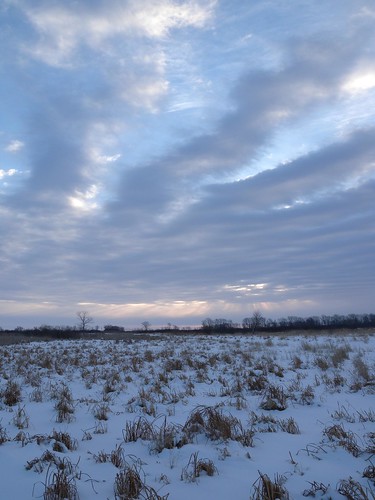 |
| Snowy Sedge Meadow Sunrise |
I arrive at Poygan State Wildlife Area at 6:32, sunrise was at 6:31 but there is no danger of missing anything today, the overcast skies have taken care of that. Time to strap on my snowshoes. They are wooden, bound together with rawhide. They are out of date, just like the film camera in my backpack, unlike the digital camera around my neck and the GPS now turned on. I take off over the marsh sedges, grasses, and flowers buried under snow, their empty seed pods and heads sticking out of the snow. I try to recognize them: blue-vervain, marsh milkweed, asters, mints, wool grass, tussock sedge, etc. I see way too much reed canarygrass. “Go away and stop consuming this sedge meadow!” I cross one of the many drainage ditches. For a time I follow another snowshoer’s trail. This trail visits one rat house after another. I guess it won’t be long before a bundle of Muskrat pelts are on their way to Russia, or maybe China. The fur trade never ended.
 |
| Mink Feet |
The wind has kicked up. I set up the big camera on its tripod. The cold bites at my fingers and the metal camera sucks the heat from them. Ten minutes later the picture is taken, I’ll see if it turns out in a month or so. I turn around to see the clouds breaking up and snap a quick photo with the digital camera. It will be the only camera I use for the rest of the day. I trudge through the marsh for an hour, listening to ravens and the wind before taking the ridge of spoils (dredge material) along the drainage ditch. All along and in the ditch were tracks from the night before alongside the tracks from many days ago. Coyote tracks crisscrossed every which way while the tracks of mink and muskrat stay within several feet of the ditch. I like mink. Like many weasels they are curious and energetic. They've often stopped to watch me as I stopped to watch them. I find a hole then several more where they entered the water. Each hole is linked by the foot prints and belly slides of another weasel, the River Otter. One otter trail breaks from the ditch to the bank where the otter slid repeatedly down the spoil bank for no other reason than fun. There must be enough fish, frogs, etc. in this ditch to keep the otter fueled all winter. I’m somewhat surprised.
Then it’s back to the car. At the car there is the smell of skunk in the air and their tracks on the ground. I lower my backpack into the car, my back is relieved to have the pack off, and my stomach glad for a granola bar. I take off my now sweaty jacket, scan the horizon one last time and head home.
 |
| River otter trail: line moving from center to right. Wildlife biologists use these distinctive trails to conduct otter population surveys from the air. |
Saturday, February 19, 2011
Phantoms
This morning with my big clumsy camera mounted on its tripod I stood in the cold with a huge full moon setting over my shoulder and the camera pointed to the glow in the east. I waited for the perfect light, by the shore of Willow Creek, listening to occasional booms of the shifting ice. Suddenly, to the north across the creek, I heard some animals coming out of the cattails and preparing to cross the creek. Almost as soon as the two coyotes came out of the cattails, we saw one another. While the second coyote immediately turned and headed back into the cattails, the first looked at me and kept trotting across the ice. It paused momentarily to get another look at me and disappeared into the marsh. Although most of my encounters with coyotes have been brief glimpses in the headlights, one morning as a kid waiting for the bus at the end of our 500 ft driveway in thick fog, three shadows emerged a hundred feet away, making a quick circle on the road and disappearing without having ever made a sound. Crossing a section of marsh along the Rat River this winter, I came upon a place where many coyotes’ trails converged. In this spot the snow was so covered with coyote tracks that there was no space within an eight foot circle without a footprint in the fresh snow. I stood in the center imagining the night before when the pack greeted each other with sniffs and licks, and perhaps yipping and howling before heading off on a hunt.

Sightings of coyotes in the country are often followed by a hasty trip to the gun cabinet. That is why they disappear into the brush almost as soon as they appear. Perhaps that is the reason almost every time I heard the coyotes howling in my childhood was when their calls were masked by the passing freight trains. That is why this blurry photo I hastily took with my point-and-shoot camera is very fitting. Coyotes are phantoms of the marsh, forest, and field.
Friday, February 11, 2011
Counting Bird Nests
 |
| Black-crowned Night Heron Nest and Eggs |
Last May I was lucky enough to help two of my colleagues with the DNR, Sumner Matteson and Art Techlow counting White Pelican nests on Lake Winnebago and Lake Butte des Morts. Along with the Pelicans we found the nests of: Great Egrets, Black-Crowned Night Herons, Great Blue Herons, Double Crested Cormorants, Mallard Ducks, Canada Geese, Ring-billed Gulls and Herring Gulls. I guess I was also luck enough to only get hit three times by “bird bombs.”
 |
| Great Egrets and Nests |
Subscribe to:
Posts (Atom)