Showing posts with label Northern Hardwood Swamp. Show all posts

Sunday, May 29, 2011

Plant of the Week: American Basswood (Tilia americana)


American Basswood (Tilia americana) Leaves

Basswood (sometimes called Linden) is a tree found in our swamps, but it's also happy on our uplands.  The seeds are dispersed on a unique structure that catches the wind. 
The tree is also a valued street tree, as is its European cousins and hybrids.  The honey made from the flowers of basswood is considered excellent.  Native Americans and pioneers used the inner bark to make rope.  Basswood is prized for its soft clear wood by wood carvers and almost no one else, therefore it ends up in pallets, excelsior, interior furniture parts, etc.

More on American Basswood 


Young American Basswood Bark

 
Old Basswood Bark

Monday, May 2, 2011

Plant of the Week: Jack-in-the-pulpit (Arisaema triphyllum)


Jack-in-the-pulpit Wuakau Creek, WI

This common spring wildflower is easy to overlook in the moist woods and swamps where it is found.  However, once located it is an interesting if not beautiful wildflower.  The flower is formed in a special way called a spathe, reminiscent of carnivorous pitcher plants.  This is the flower of the plant and not a modified insect-eating leaf like that of the pitcher plant, although it often traps insects.  The plants produce flowers of different sexes depending on how much reserves are stored in an underground stem called a corm.  The fertilized female flowers produce a cluster of bright red berries in fall (Eastman 1992).

More about Jack-in-the-Pulpit

Wednesday, April 6, 2011

Spring Update 1

Ash tree on stilts

Tuesday (4/5/2011) I took another little trip to the Poygan State Wildlife Area to check on the advancement of spring.  Again the morning was filled with the sounds of sandhill cranes, and many ducks and geese were flying, but not as many as a few weeks ago.  I walked along the ditches and waded a short distance into the swamp to take a picture of the flooded forest.  I set the tripod in the water and ice and headed back to high ground to grab my film and light meter.   I made my composition, tripped the shutter and headed back to dry ground.  Apparently for the whole ten minutes this took me, a barred owl was perched in a large silver maple directly above me.  I did not notice it until it silently flew off.

I continued to walk along the ditches of the wildlife area.  I saw my first frogs of the year, two leopard frogs basking in the early April sun. I saw another amphibian while heading across the sedge meadow; there was a small area of deeper water (14 inches) with a thin layer of ice on top surrounding a muskrat house.  As I broke through the ice with my big feet I frightened a tadpole under the ice and it swam away with surprising speed. 

Some of the birds along Black Hawk Road

Flooded farm fields make a good stop over for waterfowl
Tundra swan - 6
Pintail – 7
Mallard – 163
Blue-wing teal – 2
Green-wing teal – 2
Canada goose – 27
Wood duck – 2
Bald eagle – 1
Kingfisher – 1


Part of large school of carp
After that it was off to Waukau Creek to see if any fish were heading upstream to spawn, or in the case of carp, perhaps feed on eggs.  At the dam and pond there is an overflow channel that ends in a carp barrier.  At the base were a dozen northern pike on their spawning migration waiting for the right moment to try and make it over the barrier.  The biggest fish might have been 26 inches.  I walked the length of this channel and a little farther (750 ft) and counted 55 northern pike (1 every 14 ft), most of which my grandfather would have referred to as "gas pipes" (he was a master plumber).   Watching at the base of the carp barrier the water boiled and every few minutes I would see one of these little northern fight to make it upstream and get tossed back.  If the little guys are fast and lucky they might make it past the bars of the barrier, but I doubt any of the larger females will make it past to the lush spawning grounds of Rush Lake.  If you have the chance to check it out they may still be there for the next couple of days.  
Four northern pike bellow carp barrier at Waukau Creek

Monday, March 21, 2011

Plant of the Week: Skunk Cabbage (Symplocasrpus foetidus)

Skunk Cabbage flowers and emerging leaf

During those first spring hikes the family took each year along muddy lake shores and creek bottoms, my parents pointed out skunk cabbage.  Related to neither skunks nor cabbage, this strange plant was one of the first wildflowers I recognized as a kid, although I don’t think I knew at the time that it was actually the flowering part I was looking at. 

The plant is a mimic.  Many flowers we are familiar with are brightly colored, and aromatic.  These are advertisements to bees, butterflies and a host of other insects that there is a source of pollen and nectar to drink.  These insects visit other plants of the same species, carrying pollen and ensuring cross-pollination.  The skunk cabbage takes a different strategy.  The freezer that is winter stores up the carcasses of animals that died of disease, starvation, accidents, hunting, and old age.  The not-so-pretty side of nature is revealed as the snow melts.  When the carcasses emerge, so do flies and other insects that feed and lay eggs on carrion.  The skunk cabbage emerges at the same time, producing its own heat and melting the surrounding snow.  It takes on the look of flesh and produces a fetid smell, attracting insects that will then transfer pollen from one plant to another.  The poor flies fall for the false advertising millennium after millennium, ensuring another generation of skunk cabbage.  

Thursday, March 10, 2011

Plant of the Week: Swamp-White Oak (Quercus bicolor)

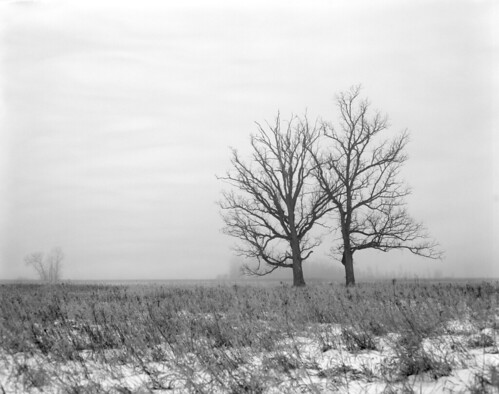
Two Oaks - Purchase Photo
Swamp White Oak is a common component of our Northern Hardwood Swamps.  Like all oaks it produces acorns, which are relished by squirrels, chipmunks, deer, blue jays and crows.  Squirrels and blue jays often cache the extra bounty of acorns by burying them, and inadvertently planting the next generation of oaks.  Squirrels don’t remember where they bury the acorns, and rely on their sense of smell to find them at anytime of the year.  Oaks fall into two categories:  red oaks and white oaks.  Red oaks have pointy leaves and bitter acorns that take two years to mature.  Contrastingly, the leaves of white oaks have rounded leaf tips, and sweeter acorns that mature their first year.  Because they are sweeter they are preferred by wildlife and the few humans that still like to make flour out of acorns after leaching them of tannins.  Many white oak species are resistant to rot--swamp white is no exception-- and many of the ancient tilted wooden fence posts in Wisconsin are made from different species of white oaks.

A great resource on the trees of Wisconsin is actually Michigan Trees by Burton V. Barnes and Warren H. Wagner Jr., from which some of the above information is obtained.