More about Spotted Joe-Pye Weed
Showing posts with label Plants of the Week. Show all posts
Friday, September 2, 2011
Plant of the Week: Spotted Joe-Pye-Weed (Eupatorium maculatum)
More about Spotted Joe-Pye Weed
Labels:
Plants of the Week,
Sedge Meadow,
Wetland
Location:
Poysippi, WI, USA
Sunday, August 21, 2011
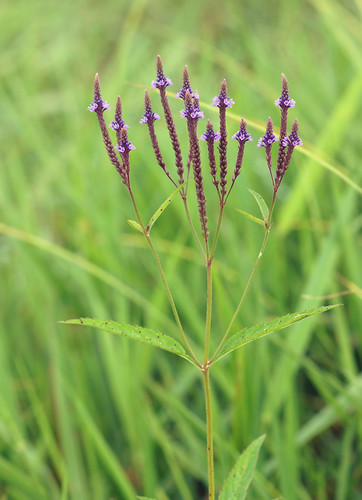
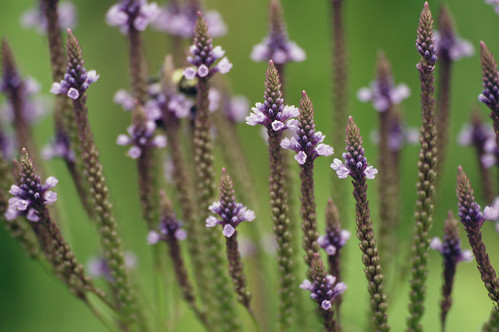
Plant of the Week: Blue Vervain (Verbana hastate)
| Blue Vervain (Verbana hastae) |
Labels:
Plants of the Week,
shoreland restoration,
Wetland
Friday, August 12, 2011
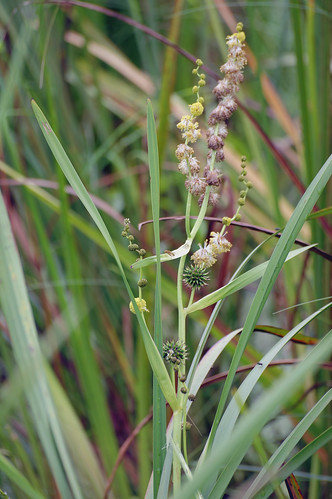
Plant of the Week: Common or Giant Bur-reed (Sparganium eurycarpum)
| Common Bur-reed (Sparganium eurycarpum) |
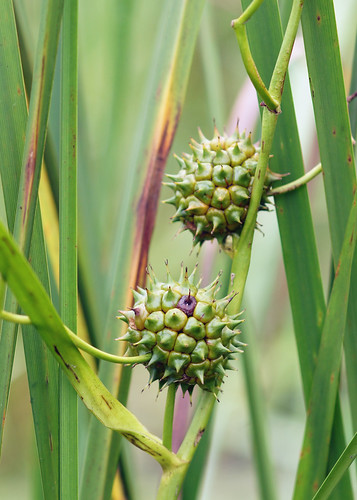
Common bur-reed is an emergent plant of shallow water with sword-shaped leaves and mace-shaped seed heads. The corn kernel-sized seeds (achenes) are often eaten by waterfowl and shore birds. Muskrats eat the entire plant, and the tubers are edible by humans.
More about Bur reed
More about Bur reed
| Common Bur-reed (Sparganium eurycarpum) Inflorescence |
Common Bur-reed (Sparganium eurycarpum)
Seeds (achenes) |
Labels:
"Poygan State Wildlife Area",
Common Bur-reed,
Marsh,
muskrat,
Plants of the Week,
Sparganium eurycarpum,
Waushara County"
Location:
Poysippi, WI, USA
Thursday, July 21, 2011
Plant of the Week: Spatterdock (Nuphar advena)
| Spatterdock (Nuphar avenda) West Bay Cane Beds -Lake Poygan |
In bloom right now is one of the two species of water-lily that are present in the Winnebago Pool. Spatterdock, sometimes referred to yellow water-lily (which is actually a different species), can be differentiated between our other species-- white water-lily-- by its heart-shaped leaves. White water-lily leaves are more circular. All water-lily leaves have a cleft. Water lilies are some of those pretty “weeds” that most people don’t mind. The other reason people tolerate and even love water lilies is because they often hold largemouth bass and northern pike. Lily pads are home to many species of insects, and later in the summer you can see holes were they have been feeding. Water-lilies are sometimes confused with American lotus which often emerges out of the water on its stalk, and its leaves have no cleft. Water-lilies are not related to true lilies.
More information on Spatterdock
Labels:
Lake Poygan,
Nuphar avenda,
Plants of the Week,
Spatterdock,
West Bay Cane Beds,
Winnebago County
Location:
Poygan, WI, USA
Monday, May 2, 2011
Plant of the Week: Jack-in-the-pulpit (Arisaema triphyllum)
| Jack-in-the-pulpit Wuakau Creek, WI |
This common spring wildflower is easy to overlook in the moist woods and swamps where it is found. However, once located it is an interesting if not beautiful wildflower. The flower is formed in a special way called a spathe, reminiscent of carnivorous pitcher plants. This is the flower of the plant and not a modified insect-eating leaf like that of the pitcher plant, although it often traps insects. The plants produce flowers of different sexes depending on how much reserves are stored in an underground stem called a corm. The fertilized female flowers produce a cluster of bright red berries in fall (Eastman 1992).
More about Jack-in-the-Pulpit
Sunday, April 17, 2011
Plant of the Week??? Lichens
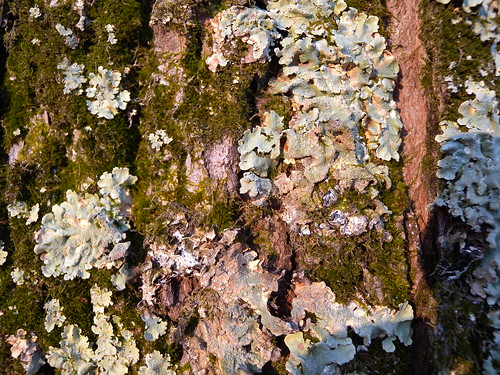
| Lichen growing on willow bark |
Lichens are not truly plants, they’re not even a single organism. These crusty, sometimes mossy looking things growing on trees and rocks are actually an algae and a fungus living together. The fungus (mycobiont) gets nutrients from its substrate and gives it to the algae (photobiont), and the algae makes food (carbohydrates) through photosynthesis and gives it to the fungus. I use the word “gives” liberally, some would argue the organisms are stealing from each other.
Lichens live in some harsh places on earth, surviving intense ultraviolet radiation and temperatures in excess of 130°F, and eat bark and rocks. That’s pretty hardcore. That makes it ironic that they are good indicators of pollution. Lichens are susceptible to pollution found in rain and the air. They have no true roots and must take in all their moisture from the air. They don’t have the luxury of the filtering effects of soil. I don’t really think of Oshkosh as a big dirty city, but its lack of lichen diversity indicates that there is more pollution than the countryside. Today, pollution is less visible. We might not notice any sources if it were not for the water vapor visible from our tail pipes and furnace exhaust on cold days, but it is there and does have an effect on everything and everyone including the toughest organisms on earth.
| Lichen growing on living ash bark |
Labels:
Plants of the Week
Location:
Winchester, WI, USA
Monday, March 21, 2011
Plant of the Week: Skunk Cabbage (Symplocasrpus foetidus)
| Skunk Cabbage flowers and emerging leaf |
During those first spring hikes the family took each year along muddy lake shores and creek bottoms, my parents pointed out skunk cabbage. Related to neither skunks nor cabbage, this strange plant was one of the first wildflowers I recognized as a kid, although I don’t think I knew at the time that it was actually the flowering part I was looking at.
The plant is a mimic. Many flowers we are familiar with are brightly colored, and aromatic. These are advertisements to bees, butterflies and a host of other insects that there is a source of pollen and nectar to drink. These insects visit other plants of the same species, carrying pollen and ensuring cross-pollination. The skunk cabbage takes a different strategy. The freezer that is winter stores up the carcasses of animals that died of disease, starvation, accidents, hunting, and old age. The not-so-pretty side of nature is revealed as the snow melts. When the carcasses emerge, so do flies and other insects that feed and lay eggs on carrion. The skunk cabbage emerges at the same time, producing its own heat and melting the surrounding snow. It takes on the look of flesh and produces a fetid smell, attracting insects that will then transfer pollen from one plant to another. The poor flies fall for the false advertising millennium after millennium, ensuring another generation of skunk cabbage.
Location:
Poysippi, WI, USA
Thursday, March 10, 2011
Plant of the Week: Swamp-White Oak (Quercus bicolor)
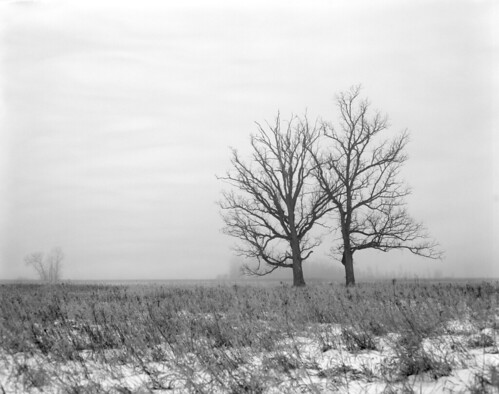
| Two Oaks - Purchase Photo |
Swamp White Oak is a common component of our Northern Hardwood Swamps. Like all oaks it produces acorns, which are relished by squirrels, chipmunks, deer, blue jays and crows. Squirrels and blue jays often cache the extra bounty of acorns by burying them, and inadvertently planting the next generation of oaks. Squirrels don’t remember where they bury the acorns, and rely on their sense of smell to find them at anytime of the year. Oaks fall into two categories: red oaks and white oaks. Red oaks have pointy leaves and bitter acorns that take two years to mature. Contrastingly, the leaves of white oaks have rounded leaf tips, and sweeter acorns that mature their first year. Because they are sweeter they are preferred by wildlife and the few humans that still like to make flour out of acorns after leaching them of tannins. Many white oak species are resistant to rot--swamp white is no exception-- and many of the ancient tilted wooden fence posts in Wisconsin are made from different species of white oaks.
A great resource on the trees of Wisconsin is actually Michigan Trees by Burton V. Barnes and Warren H. Wagner Jr., from which some of the above information is obtained.
Thursday, February 24, 2011
Virginia Creeper (Parthenocissus quinquefolia)
![]() |
| Virginia Creeper |
Virginia creeper-- also called woodbine--are vines that are not restricted to wetlands. They are found in our forests, thickets, backyards, and swamps. There are two species in Wisconsin. One (P. quinquefolia) secretes an adhesive from its disks on its tendrils and can climb brick walls like Boston ivy, the other (P. vitacea) has regular wrapping tendrils only.
The photo shown here illustrates Virginia creeper’s amazing fall colors, thought to attract birds to their nutritious fruit. I use it in my yard to provide a screen, cover up my rusty wire fence and provide cover and food for wildlife such that there is in Oshkosh. You’ll notice mixed in with my backyard Virginia creeper’s leaves are those of its cousin, domestic grapes (Vitus vinifera). The grapes don’t do as well in the mixed shade so I planted the creepers, and they are doing amazingly well. Unlike grapes, Virginia creeper berries are inedible for humans, and toxic in large quantities.
Saturday, February 19, 2011
Red Osier-Dogwood, Cornus stolonifera
Several of our native shrubs have subtle beauty, but none have the year-round color of Red Osier-Dogwood. It is commonly found coloring Shrub-Carr wetlands, which are essentially natural communities made up of shrubs on wet/saturated soils. It can form thick stands with few other shrubs or trees present. Unfortunately this shrub, although native, can invade and replace sedge and wet meadows, because of fire suppression and water table changes caused by drainage.
Although an invasive in disturbed wetlands, you shouldn’t hesitate to plant it in your yard. They grow well on drier soils, have attractive red bark, provide good hiding and nesting places for birds and the berries are a great food for them as well. Red dogwood is the first shrub I remember as a kid. We had some growing along the road by our mailbox. Each summer the county would cut it down and it rebounded happier than ever. These new shoots are much redder than the old ones, and so regular trimming of the red dogwoods in your landscape will give a more pleasing look, especially in monotone winter.
| Shrub-carr |
Labels:
Plants of the Week,
Shrublands
Location:
Oshkosh, WI, USA
Monday, February 7, 2011
Eastern White Cedar (Thuja occidentalis)
Every plant book begins by telling you that this really isn’t a true cedar like those of Lebanon, it is closely related to cypress. I feel better now that’s out of the way, but the next thing they’ll mention is the plant is sometimes called Arborvitae, which means “tree of life.” It is believed to be given this name because a tea brewed from its leaves contains vitamin C and can prevent and cure scurvy. Arborvitae can be found in all shapes and sizes at garden centers. In our local wetlands, white cedar is a minor player, but in other parts of Wisconsin, it is the dominant tree in many swamps.
White Cedar often forms dense stands that are important winter areas for white-tailed deer. Deer will browse all the foliage they can reach leaving a distinctive browse line in the swamp, or in your garden. When deer population are too high no cedar seedling will ever grow into a mature tree. It has been said that without recruitment the cedar swamps in the North Woods may die out. Maybe the current dip in the deer population will allow for a period of cedar recruitment.
![]() |
| Cedar Cones |
For many Native Americans the white cedar was and is a sacred tree with many uses. The Chippewa used the wood for sturgeon spears , so if you’re looking to make a traditional spear go with cedar. Cedar is still used for arrow shafts. Its wood is rot resistant and is used in fence posts, bird houses, and over my head 110 year old cedar shakes are keeping the snow out with the help of three or four layers of asphalt shingles. Anybody want to help put on a new roof?
Tuesday, February 1, 2011
Plant of the week: Marsh Milkweed (Asclepias incarnata)
Because there might be some time between photo expeditions and film processing, I’ll be posting a photo and a little information on one of our wetland or aquatic plants, although I’ll occasionally add fish and wildlife. Our plant this week is Marsh Milkweed, one of the prettiest plants you can find at the water’s edge, or deep in the marsh. Because it isn’t fussy it makes a great candidate for native shoreland restorations. Not only are its magenta blooms gorgeous, they attract butterflies and like common milkweed the foliage is fed upon by Monarch caterpillars. If you leave the stem up through the winter, in spring you may watch birds tearing off the fibrous outer strips of the stems. It makes great nesting material and great cordage. I once made some twine from a single common milkweed stem and found it impossible to break with my hands.
Some of the information discussed in Plant of the Week will be taken from The Book of Swamp and Bog by John Eastman. I highly recommend this book if you want to go beyond simply identifying the local flora. He also has two other books: The Book of Field and Roadside, and The Book of Forest and Thicket. I highly recommend them all.
Subscribe to:
Posts (Atom)