Showing posts with label Marsh. Show all posts

Tuesday, January 8, 2013

Under a Frozen World


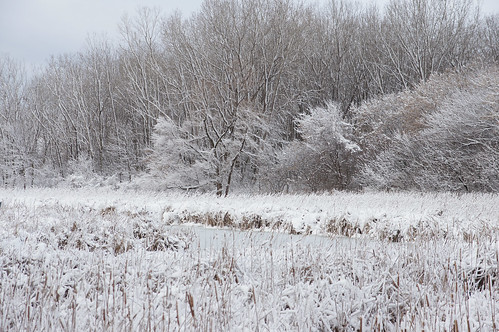
Snowy Wetland
Slough off North Asylum Bay
The lakes and marshes become quiet in the winter when the ice covers the lakes and snow blankets the surrounding marshes, but life continues below ice and snow. 

Tunneling through the snow are a number of little mammals.  Mice, voles, and shrews enjoy the relative safety provided by their tunnels.  There they are free from the piercing eyes of hawks, but are still vulnerable to the ears and talons of great-horned owls and pouncing foxes.
On the lake bottoms are the flying insects of summer.  The billions of lake flies of spring are all there as the larva called bloodworms.  Keeping company with sediment, decaying plants, and rocks are the larvae of caddisflies, damselflies, dragonflies, and mayflies that will emerge from the lake and take flight in spring and summer.  All of these are food throughout the winter for bluegills, perch and other fish. 

Up the food chain there are reptiles we envision hibernating in the mud.  Some turtles and frogs are indeed buried in the mud, but others are piled up sitting on the lake bottom motionless or crawling along at a snail’s pace.  Common map turtles sit on the bottom or wedge themselves amongst rocks and logs.  When disturbed they retreat, and may reveal a northern leopard frog underneath, which will also swim away.  Hardly asleep, these map turtles require more oxygen than painted turtles buried in the sometimes anoxic mud.  The cold and relative inactivity allows them to take in all the oxygen they need from water.  Frogs and softshell turtles breathe through their skin, but softshells also take in oxygen through special adaptions in their throats.   
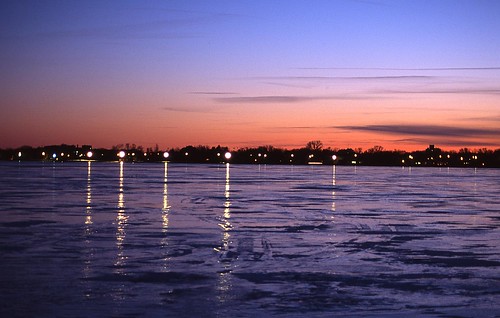
Oshkosh Ice Night
Frozen Lake Winnebago at Oshkosh

Mammals have no options but to breathe air.  The local aquatic members of the weasel family--river otter and mink--must maintain holes in the ice with their teeth to be able to gain access to the fish, frogs, turtles and other animals they eat.  Muskrats often use the same holes, but they try to stay concealed, and will never walk on ice and snow if they can avoid it.  Muskrats build huts, or lodges like beavers do, but muskrat homes are made of aquatic plant leaves, stems, and roots.  Here they sleep and eat, but they often swim far beyond the range of one breath to obtain the food they need.  For those foraging trips they build cave-like “push ups” for breathing.  They will also build small feeding huts, which are self-explanatory.  A sudden drop in water levels after the ice forms seals off all these structures from the muskrats’ food, forcing them onto ice and snow and into the jaws of coyotes.    

Winter is a harsh time for wildlife, but it can be easier under the ice and snow for those adapted to it.

Previously published in the Oshkosh Scene article.

Wednesday, December 26, 2012

Little Trappers


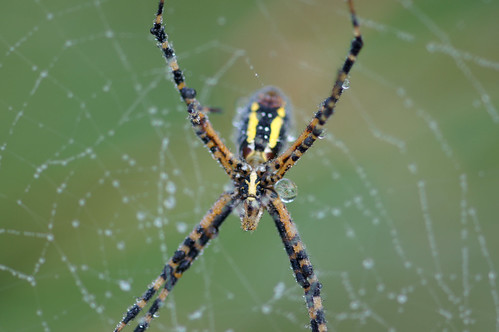
Spider Web
Orb Weaver Spider
The early morning light catches a dew speckled web in the marsh.  You can see such webs driving down the road, riding a bike, but it is best on foot.  You can observe the intricacies of the web, contemplate the mastery of the spinner with just a tiny speck for a brain, and never a teacher, or even a YouTube mentor to show it how it’s done.  Look close at the round globes of dew hanging from the web and notice the upside down, reversed and distorted world inside.  In a web you can read the story from the night before.  A hole in the web might indicate that some large insect, like a katydid crashed into the web tearing the silken threads.  You can find last night’s meal still stuck, or perhaps a snack all bundled up to be eaten later. 

If you are watching close to your feet as you walk, you’ll probably miss the web maker altogether, they will have dropped from view before you reach them.  Look ahead a little way as you walk and you’ll see them.  As you approach some will drop out of sight, but every now and then a slow approach and a cool morning the web spinner will stay dead center.   Some are small, and some are huge, at least by my standards.  These are some of the orb weaver spiders.  I could tell you some facts about orb weavers, but I must admit I’d have to go research them, and for me the orb weavers are like stars, they are for looking at in wonder.  I care not for the names of stars, what they are made of.  I may know some of those things, but when I look up at the sky it is a time to feel; to feel awe, to feel small and not to think.  When I look deep into the many eyes of the orb weavers I feel afraid, and feel it is time to move on.  Go search out the orb weavers if you dare.  You can find them in the marshes, prairies, and fields all around.  

Dew Web
Fly Eater


Previously published in the Oshkosh Scene.

Monday, May 14, 2012

2012 Flood

High water over the last week and a half is talking its toll on both wildlife and habitat.  Those familiar with habitat on the Winnebago Upper Pool Lakes know that thousands of acres of marsh have been lost because of the break up of floating "bogs".  When water rises the intertangled roots that from a sort of sod rip from the underling soil and float.  During high winds or ice break up in spring these mats break off and float down and usually disintegrate in Lake Winnebago.  When there was more marsh hundreds of acres could be lost in one event.  Friday a steady wind developed and began ripping the marsh apart one small piece at a time.  I witnessed a dozen of these small mats floating within the break wall at Terrell's Island and coming out of the Fox River at Lake Butte des Morts.

Cattail mat
Floating cattail "bog", exiting Terrell's Island marsh.  

High water also plays havoc with birds nesting close to the water's surface.  During a nest count May 8th with the DNR I observed perhaps a hundred flooded pelican nests and a dozen or so drown chicks, and the water was still rising.  

Bird Colony
American White Pelican nesting in cattail marsh, now flooded.
Flooded eggs
Pelican nest in the process of being flooded.  Parents were
still attempting to incubate partially flooded nests.  

Thursday, October 13, 2011

Page's Slough Plant Survey

Dense vegetation in Page's Slough

Page’s Slough is a backwater of the Wolf River, just upstream of Lake Poygan, but at first glance it looks like it drains directly into the lake.  Like most things on the Winnebago System, Page’s Slough is big, about 139 acres.  Essentially, it is a shallow water lake.  This big backwater is managed for fish and wildlife habitat.  In the past the slough has had an abundant population of curly-leaf pond weed, an invasive species, and early this summer it was observed to be abundant.  It was feared native plants would be hurt.  Curly-leaf pondweed is different than our native vegetation in that it begins to grow in fall, comes on strong in the spring and early summer, and begins to die back in late June, or early July.  If it came on strong then it might have strangled the native vegetation. 


The Demented Gardener
On a nice day in late August I’m there with Art Techlow, DNR, and my wife and note taker Rebecca.  I stand at the bow with a modified garden rake in hand, looking like some kind of demented gardener.  The rake  is metal, with two sets of teeth back to back, and has an eight foot metal pole.  Art pilots the boat from one predetermined GPS point to another, and I drop the rake down, spin it around and 93% of the time I pull up a green spaghetti of aquatic plants in muck sauce.  Most of the plants are coontail and Canadian waterweed (Elodea); these aren't particularly good plants for waterfowl in themselves, but they feed and hide millions of insects, crustaceans, and small fish relished by the birds.  Page’s Slough is packed with vegetation, the vast majority of it native.  Since this is only an observational study and not an experiment, I can’t say much for sure.  All I know is that this year’s abundant curly-leaf pondweed seems to have had little negative impact, no impact, or an undetermined positive impact on the abundance of native vegetation.  In any case it is good for this lake…I mean slough.

Friday, August 12, 2011

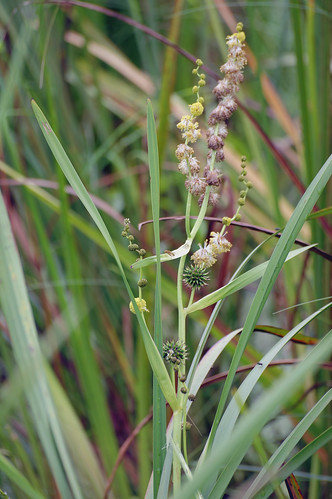
Plant of the Week: Common or Giant Bur-reed (Sparganium eurycarpum)


Common Bur-reed (Sparganium eurycarpum)
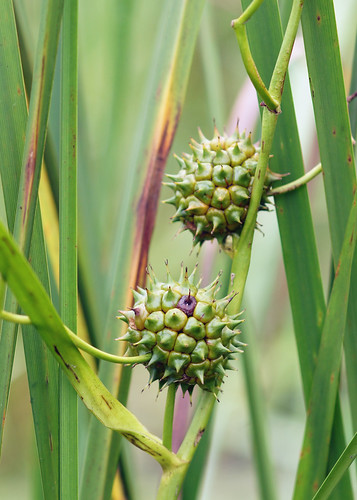
Common bur-reed is an emergent plant of shallow water with sword-shaped leaves and mace-shaped seed heads.  The corn kernel-sized seeds (achenes) are often eaten by waterfowl and shore birds. Muskrats eat the entire plant, and the tubers are edible by humans.

More about Bur reed

Common Bur-reed (Sparganium eurycarpum)
Inflorescence
Common Bur-reed (Sparganium eurycarpum)
Seeds (achenes)

Saturday, May 28, 2011

What is a Marsh and what is a Swamp?

Marshes and swamps are two different things. A marsh is a place with standing water or soils saturated with water throughout most of the year, and grass-like vegetation:  cattails, sedges and grasses.  Swamps have the same moisture requirements, but are dominated by trees and shrubs.  They are more often flooded or saturated for shorter time periods.  In coming posts I will discuss the unique characteristics that define specific plant communities.  To help identify these plant communities I recommend a book published by the US Army Corps of Engineers (USACE):  Wetland Plants and Plant Communities of Minnesota and Wisconsin by Eggers and Reed.  You can view the entire book here, or purchase it here.  You can also learn more on my new website by clicking Wetland Plant Communities


An older addition

Shallow, Open Water Communities
Deep Marsh
Shallow Marsh

Local Swamps


Shallow Water Marsh : Poygan State Wildlife Area