Monday, May 14, 2012

2012 Flood

High water over the last week and a half is talking its toll on both wildlife and habitat.  Those familiar with habitat on the Winnebago Upper Pool Lakes know that thousands of acres of marsh have been lost because of the break up of floating "bogs".  When water rises the intertangled roots that from a sort of sod rip from the underling soil and float.  During high winds or ice break up in spring these mats break off and float down and usually disintegrate in Lake Winnebago.  When there was more marsh hundreds of acres could be lost in one event.  Friday a steady wind developed and began ripping the marsh apart one small piece at a time.  I witnessed a dozen of these small mats floating within the break wall at Terrell's Island and coming out of the Fox River at Lake Butte des Morts.

Cattail mat
Floating cattail "bog", exiting Terrell's Island marsh.  

High water also plays havoc with birds nesting close to the water's surface.  During a nest count May 8th with the DNR I observed perhaps a hundred flooded pelican nests and a dozen or so drown chicks, and the water was still rising.  

Bird Colony
American White Pelican nesting in cattail marsh, now flooded.
Flooded eggs
Pelican nest in the process of being flooded.  Parents were
still attempting to incubate partially flooded nests.  

Thursday, March 15, 2012

Waukau Creek Salmon

Fish migration
Small northern pike running the rapids


Fish were once again heading up Waukau Creek to try and spawn in Rush Lake.  Most will be blocked by the carp barrier, but they try until they are exhausted.  Yellow perch, northern pike, white sucker, and other species of sucker all play salmon as they attempt to run the rapids.


Northern Pike
Exhausted pike (7 inches long)  mostly out of water
Fish launch
Yellow perch attempting flight

Talk on White Pelicans and Double-Crested Cormorants

Art Techlow III, DNR biologist, will discuss the exploding population of white pelicans and double-crested cormorants in the area— what’s true, and what’s not—and what the DNR is doing to help manage these large birds.

This is a Lakes Council Speaker Series event. The public is invited.

Wednesday, March 28, 2012
At the Stone Toad:
1109 Oneida Street
Menasha, WI 54952

http://www.stonetoadbarandgrill.com/

Friday, January 20, 2012

Odds and Ends #2

Coontail Growth Time Lapse


Fishy Foo,  Photos of sunfish (centrachids) from my aquarium.
Panfish side view
Young Bluegill (Lepomis macrochirus)

Panfish in aquarium
Young green sunfish (Lepomis cyanellus)

Fish Eyes
Head on view of a bluegill

Thursday, January 12, 2012

Odds and Ends #1

# 1 Signs

Much of the current lake bottom of Butte des Mort, Winneconne, and Poygan was once marsh which was owned
by farmers and hunting clubs, so the lake bottom is the property of some individuals.  There is practically nothing
you can do with the property other than not have duck hunters place blinds on it.  
I find it pathetic that those who benefit the most from public land are those who abuse it the most.  However, it is
 certainly the minority of hunters that blast signs.  This sign shows a partnership between Pheasants Forever and the
DNR to clean up the area, and what better way is there to show your appreciation that to turn the sign into trash.

Thursday, January 5, 2012

Waiting for the Eastern Glow

Dawn Wetland
Predawn Glow
It has been far too long since I’ve watched the sun rise, or set.  Today I took the time to watch the sun come up over Poygan Marsh.

Sunday, December 18, 2011

Ice Returns

The ice has returned over the last few weeks.  Lurking under a pile of grass at the water’s edge of some slough or bay are some slivers of ice.  There they will hold out until the weather turns cold again.  First they will spread their cold fingers throughout the ditches, sloughs.  Next will be the bays and the leeward shores of the lakes.  Then on some cold, clear, calm night Lake Winnebago will be encased in a thin black prison that will thicken, gather snow, and then the well-insulated feet of ice fisherman and finally their Suburbans, Explorers, and F150s.  The marshes are lonely and quiet, the ice of the lakes is lonely too, but the ice grumbles and booms as the temperature changes and the wind blows.  On an angry night in late winter, the ice, weakened by the coming spring, will team up with the wind to invade the land, crushing docks, trees, sheds and everything in its path.  The ice will sit stacked up in shame at the water’s edge watching the sun overhead end its reign over lake and slough.  The ice will not be thought of again until those first frosts end summer, and in October and November, little slivers of ice hide under marsh grass and advance and retreat, advance and retreat...

Duck weeds and water meal locked in ice

Monday, October 31, 2011

Winnebago Pool Lakes Conference

The Winnebago Lakes Council will host the second annual Winnebago Pool Lakes Conference on Saturday, November 5th.  The event will take place 8:45 am to noon at the Fin n’ Feather in Winneconne

The annual meeting of the Council will be held at 9:30 am.  The speakers program will start at 10 am.  Entitled “New Views of Our Lakes and Rivers” the program includes: Diane Schauer on Aquatic Invasive Species Education and Regional Planning; Andrew Sabai on Conservation with a Camera; and Tom Barron on interpreting the Fox-Wisconsin Heritage Parkway.

A breakfast buffet is available.  Reservations are not required, but an email to info@winnebagolakes.org with the number of people planning to attend is appreciated.

The Winnebago Lakes Council promotes the long-term sustainability of Lakes Winnebago, Butte des Morts, Winneconne, and Poygan and their connecting rivers. Learn more at www.winnebagolakes.org.

Thursday, October 13, 2011

Page's Slough Plant Survey

Dense vegetation in Page's Slough

Page’s Slough is a backwater of the Wolf River, just upstream of Lake Poygan, but at first glance it looks like it drains directly into the lake.  Like most things on the Winnebago System, Page’s Slough is big, about 139 acres.  Essentially, it is a shallow water lake.  This big backwater is managed for fish and wildlife habitat.  In the past the slough has had an abundant population of curly-leaf pond weed, an invasive species, and early this summer it was observed to be abundant.  It was feared native plants would be hurt.  Curly-leaf pondweed is different than our native vegetation in that it begins to grow in fall, comes on strong in the spring and early summer, and begins to die back in late June, or early July.  If it came on strong then it might have strangled the native vegetation. 


The Demented Gardener
On a nice day in late August I’m there with Art Techlow, DNR, and my wife and note taker Rebecca.  I stand at the bow with a modified garden rake in hand, looking like some kind of demented gardener.  The rake  is metal, with two sets of teeth back to back, and has an eight foot metal pole.  Art pilots the boat from one predetermined GPS point to another, and I drop the rake down, spin it around and 93% of the time I pull up a green spaghetti of aquatic plants in muck sauce.  Most of the plants are coontail and Canadian waterweed (Elodea); these aren't particularly good plants for waterfowl in themselves, but they feed and hide millions of insects, crustaceans, and small fish relished by the birds.  Page’s Slough is packed with vegetation, the vast majority of it native.  Since this is only an observational study and not an experiment, I can’t say much for sure.  All I know is that this year’s abundant curly-leaf pondweed seems to have had little negative impact, no impact, or an undetermined positive impact on the abundance of native vegetation.  In any case it is good for this lake…I mean slough.

Monday, September 5, 2011

Summer is Winding Down

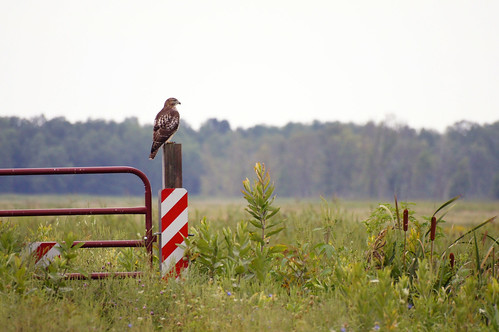
Red-tailed Hawk
I took a walk through Poygan State Wildlife Area yesterday morning.  A red-tailed hawk greeted me at the gate, and tolerated my presence probably because the hunting was good.  The sedges are beginning to change colors and many of the other plants have tinges of brown or yellow on the tips of their leaves.  Even though many are shutting down, a few are just getting started blooming.  The bumble bees seem less vigorous than they used to, these workers are burning out.  They have worked hard and none will survive the winter.  The water in the marsh's ditches is low, but filled with wood ducks, a few mallards and at least one blue-wing teal.  But there are some other interesting birds that catch my eye.
Wild Rice information

At first sight they look like birds that left the nest too soon.  They have the ungainly bodies of plucked chickens and flap their short wings in an almost hopeless flight.  These are not babies though, they are Sora--a little member of the rail family.  Like many rails, they are seldom seen.  They would rather run through the grass and sedge than take flight to escape danger.  Their flight muscles are weak, it is amazing that they will be able to migrate anywhere.  These sora are most abundant among the wild rice stems where I flush one and hear perhaps a dozen others, some only 15 feet away.  They look more like chickens than anything else, and love the wild rice grains.  Soon these little guys will be flapping those unlikely wings across the US Gulf Coast all the way to the Northern coast of South America.  Good luck guy, I'll see you--no, hear you--next year.