Monday, October 31, 2011

Winnebago Pool Lakes Conference

The Winnebago Lakes Council will host the second annual Winnebago Pool Lakes Conference on Saturday, November 5th.  The event will take place 8:45 am to noon at the Fin n’ Feather in Winneconne

The annual meeting of the Council will be held at 9:30 am.  The speakers program will start at 10 am.  Entitled “New Views of Our Lakes and Rivers” the program includes: Diane Schauer on Aquatic Invasive Species Education and Regional Planning; Andrew Sabai on Conservation with a Camera; and Tom Barron on interpreting the Fox-Wisconsin Heritage Parkway.

A breakfast buffet is available.  Reservations are not required, but an email to info@winnebagolakes.org with the number of people planning to attend is appreciated.

The Winnebago Lakes Council promotes the long-term sustainability of Lakes Winnebago, Butte des Morts, Winneconne, and Poygan and their connecting rivers. Learn more at www.winnebagolakes.org.

Thursday, October 13, 2011

Page's Slough Plant Survey

Dense vegetation in Page's Slough

Page’s Slough is a backwater of the Wolf River, just upstream of Lake Poygan, but at first glance it looks like it drains directly into the lake.  Like most things on the Winnebago System, Page’s Slough is big, about 139 acres.  Essentially, it is a shallow water lake.  This big backwater is managed for fish and wildlife habitat.  In the past the slough has had an abundant population of curly-leaf pond weed, an invasive species, and early this summer it was observed to be abundant.  It was feared native plants would be hurt.  Curly-leaf pondweed is different than our native vegetation in that it begins to grow in fall, comes on strong in the spring and early summer, and begins to die back in late June, or early July.  If it came on strong then it might have strangled the native vegetation. 


The Demented Gardener
On a nice day in late August I’m there with Art Techlow, DNR, and my wife and note taker Rebecca.  I stand at the bow with a modified garden rake in hand, looking like some kind of demented gardener.  The rake  is metal, with two sets of teeth back to back, and has an eight foot metal pole.  Art pilots the boat from one predetermined GPS point to another, and I drop the rake down, spin it around and 93% of the time I pull up a green spaghetti of aquatic plants in muck sauce.  Most of the plants are coontail and Canadian waterweed (Elodea); these aren't particularly good plants for waterfowl in themselves, but they feed and hide millions of insects, crustaceans, and small fish relished by the birds.  Page’s Slough is packed with vegetation, the vast majority of it native.  Since this is only an observational study and not an experiment, I can’t say much for sure.  All I know is that this year’s abundant curly-leaf pondweed seems to have had little negative impact, no impact, or an undetermined positive impact on the abundance of native vegetation.  In any case it is good for this lake…I mean slough.

Monday, September 5, 2011

Summer is Winding Down

Red-tailed Hawk
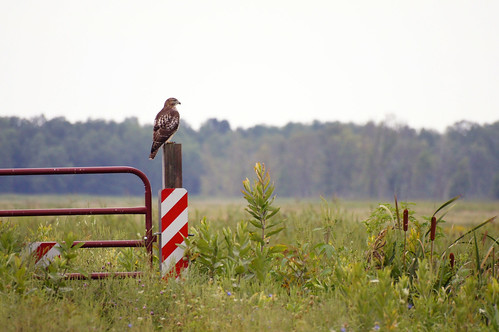
I took a walk through Poygan State Wildlife Area yesterday morning.  A red-tailed hawk greeted me at the gate, and tolerated my presence probably because the hunting was good.  The sedges are beginning to change colors and many of the other plants have tinges of brown or yellow on the tips of their leaves.  Even though many are shutting down, a few are just getting started blooming.  The bumble bees seem less vigorous than they used to, these workers are burning out.  They have worked hard and none will survive the winter.  The water in the marsh's ditches is low, but filled with wood ducks, a few mallards and at least one blue-wing teal.  But there are some other interesting birds that catch my eye.
Wild Rice information

At first sight they look like birds that left the nest too soon.  They have the ungainly bodies of plucked chickens and flap their short wings in an almost hopeless flight.  These are not babies though, they are Sora--a little member of the rail family.  Like many rails, they are seldom seen.  They would rather run through the grass and sedge than take flight to escape danger.  Their flight muscles are weak, it is amazing that they will be able to migrate anywhere.  These sora are most abundant among the wild rice stems where I flush one and hear perhaps a dozen others, some only 15 feet away.  They look more like chickens than anything else, and love the wild rice grains.  Soon these little guys will be flapping those unlikely wings across the US Gulf Coast all the way to the Northern coast of South America.  Good luck guy, I'll see you--no, hear you--next year.

Friday, September 2, 2011

Plant of the Week: Spotted Joe-Pye-Weed (Eupatorium maculatum)

Joe-Pye Weeds are among our most attractive wetland plants.  They bloom in late summer and fall,  adding a touch of color in an increasingly drab landscape.  The plant is said to be named after Joe-Pye a Native American Herbalist on the East Coast of the United States.

More about Spotted Joe-Pye Weed

Sunday, August 21, 2011

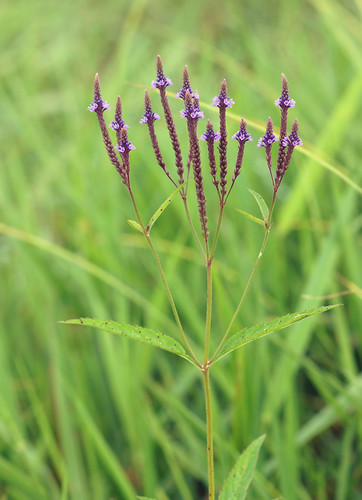
Plant of the Week: Blue Vervain (Verbana hastate)


Wild Hyssop
Blue Vervain (Verbana hastae) 
Blue Vervain is another one of those wetland plants that makes a nice addition to a shoreland restoration, rain garden, or other wet spot on your property.  The stems rise out of the snow as if in defiance of winter, and a reminder that summer will come again.  

Also known as common vervain and wild hyssop

More on Blue Vervain


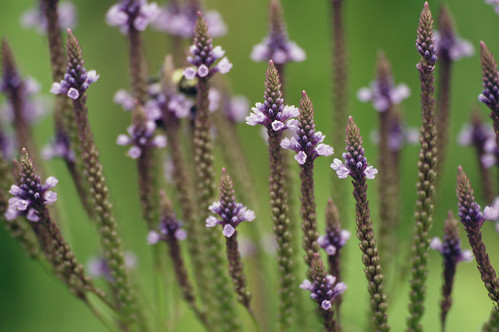
Wild Hyssop closeup
Blue Vervain Closeup 

Sunday, August 14, 2011

What is the difference: emergent, submergent floating leaf, and free-floating plants?

Simply, these terms refer to the growth habit of aquatic and wetland plants.  Some plants will have more than one habit.  Updated page on emergent, submergent, aquatic vegetation

Emergents emerge or have a large portion of their shoots, leaves or flowering structures out of the water.  These include the familiar cattails, and also bulrushes, wild rice, sedges, bur-reed and many others.

Emergent Plants: Blue Flag Iris, Tussock Sedge (Carex stricta.), Bluejoint Grass
Submergent plants have most of their structures below water.  Common examples of these would be coontail, milfoils, and many pondweeds.
Submergent Plants: Coontail, Elodea (Canadian Waterweed),
Wild Celery, Water Star-grass, Chara

Floating-leaf plants have large floating leaves.  They include the water-lilies, some pondweeds, and American lotus, although the latter often protrude from the water.
Floating-leaf plant - White waterlily (Nymphaea odorata)
Free-floating plants include the duckweeds, common bladderwort and often coontail.  Coontail is sometimes rooted, but it is dislodged easily by wave action and will continue growing in a floating mass, or tangled in with other plants.
Free-floating plant: Least Duckweed (Lemna minor)

Friday, August 12, 2011

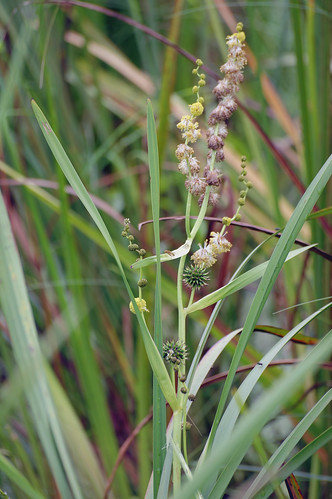
Plant of the Week: Common or Giant Bur-reed (Sparganium eurycarpum)


Common Bur-reed (Sparganium eurycarpum)
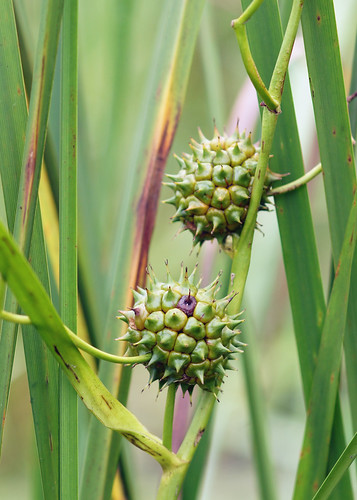
Common bur-reed is an emergent plant of shallow water with sword-shaped leaves and mace-shaped seed heads.  The corn kernel-sized seeds (achenes) are often eaten by waterfowl and shore birds. Muskrats eat the entire plant, and the tubers are edible by humans.

More about Bur reed

Common Bur-reed (Sparganium eurycarpum)
Inflorescence
Common Bur-reed (Sparganium eurycarpum)
Seeds (achenes)

Thursday, August 11, 2011

Boom Bay (Loch Ness) Goose

Here is a mysterious barnyard goose swimming with some of its cousins in Boom Bay, Lake Poygan.  The blurry photo is reminiscent of the famous Scottish monster.  Well, maybe it isn't a goose after all.  I bet it really is an immature plesiosaur.  Yes, it certainly is, no doubt about it.  I'm starting a new guiding service called "It Came From the Shallows Expeditions."  Space is filling up fast, so book your expedition now, and you're guaranteed to be on some terrible cable show.  

Enhanced photo just received from NASA's Jet Repulsion Laboratories 


Friday, July 29, 2011

Shoreland Restoration Tour

From the Winnebago Lakes Council:

Come join us on Wednesday, Aug. 17, for a tour of a variety of conservation projects designed to help improve wildlife habitats and the water quality of Lake Butte des Morts. 
All three properties are in the Omro area along the southwestern shore of the lake. The first presentation will be at 4 p.m. at 4780 Rivermoor Road. The other scheduled times are: 5 p.m., 5823 Springbrook Road, and 6 p.m., 5430 E. Reighmoor Road.
The public is invited to join the tour free of charge and talk with the property owners and members of the Wisconsin Waterfowl Association who have been involved in creating and maintaining the conservation efforts. It will be conducted rain or shine.
The projects have been undertaken with the advice and assistance of Winnebago County Land and Water Conservation staff, who arranged the tour. The event is co-sponsored by the Winnebago Lakes Council, the League of Women Voters of Winnebago County and the Fox Valley Area Chapter-Wild Ones.

Click for Map

Tuesday, July 26, 2011

A Little Trudge Through the Marsh

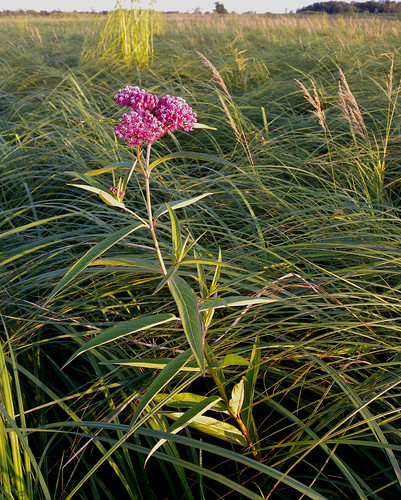
Marsh or Swamp Milkweed (Asclepias incarnata)

I have been staying away.  I've been there for quick visits many times this summer, but I’ve been away too long.  Before I step from the car the welcome committee arrives:  first deer flies swarm around the car, and then the mosquitoes land on the glass and prepare to pounce.  I take a deep breath, tuck my nose under my shirt and spray my arms and neck with OFF.  I step out of the car and gasp for air and rub a little of the insect repellent on my face.  The deer flies have formed a cyclone over my head.  I spray my hair.  I am now good and tacky and ready for adventure.  The deer flies land periodically, but take flight as soon as they touch down.  For the rest of this trudge my defenses will be constantly tested and the chinks in my armor found and exploited.  For now I can largely ignore the swarm of female insects that want to call me dinner. 

I strap on my backpack, weighed down with camera gear.  It is a movement of hope, much like buying a lottery ticket.  I don’t know if I’ll have a dry place to set it down when I’m out there, and so I don’t know if the 40 lbs is worth the effort.  I grab my walking stick for balance.  I head out and walk through a thick stand of reed canary-grass.  It is an invasive species and a plague on our wetlands.  I push back the tall grass to look and see if there are any species growing down there.  There are none.  Mosquito in my armpit, I push through another 100 feet and I’m in those grass-like sedges, a few grasses, flowers and shrubs.  This isn’t the diversity of the Amazon, but it is amazing in its own way and much better than the one species of grass just a few paces behind me.  If I should fall asleep for a year I would wake up surrounded by reed canary-grass as it advances and smothers this marsh.  I try to focus on the positive, sedges are at my feet and the sweet-smelling marsh milkweed is under my nose and a deer fly is up my sleeve.  Oh…positive thoughts.  There are short, fat, pale-green grasshoppers with comical expressions looking up from the sedges. 

Wool-grass (Scirpus cyprinus)
The sun is low on the horizon, there is no place to set down the camera bag, so I head west back to the car to maybe catch the sunset over there.  The return walk is like walking up rapids of a trout stream.  The prevailing winds have bent the sedges and grass toward me and now they provide stiff resistance.  Soon I the sweat beads on my face, the beads run together, and steady drip into and out of my eyes flow.  I huff and puff my way along, my back is soaked and the mosquitoes are watching the DEET drip off my body.  They rejoice when I take the back pack off and expose my unsprayed t-shirt, which they drill through immediately.  I set up the big camera and take some photos of the sun going down.  The sunset is pretty, but it doesn’t knock my socks off.  I turn around 180 degrees and see the cloud formations behind me are quite striking.  I set up and take their picture, pack up and drive home trough a rain of insects pelting the windshield.  As I approach Oshkosh, the fields and marshes have been decorated by thousands of flashing lightning bugs.  I pull off the road to listen to the tree frogs and watch the show.  There are no mosquitoes.  I think they are watching the show too.