Tuesday, July 26, 2011

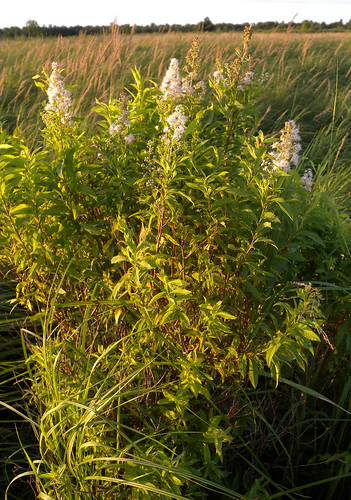
Plant of the Week: Meadowsweet (Spirea alb)


Meadowsweet looks similar to its close relative, steeple bush, which is often found in Wisconsin wetlands.  Other spirea species can be found in garden centers.

More on White Meadowsweet


Meadowsweet (Spirea alba)

Thursday, July 21, 2011

Plant of the Week: Spatterdock (Nuphar advena)

Spatterdock (Nuphar avenda)
West Bay Cane Beds -Lake Poygan
In bloom right now is one of the two species of water-lily that are present in the Winnebago Pool.  Spatterdock, sometimes referred to yellow water-lily (which is actually a different species), can be differentiated between our other species-- white water-lily-- by its heart-shaped leaves.  White water-lily leaves are more circular.  All water-lily leaves have a cleft.   Water lilies are some of those pretty “weeds” that most people don’t mind.  The other reason people tolerate and even love water lilies is because they often hold largemouth bass and northern pike.  Lily pads are home to many species of insects, and later in the summer you can see holes were they have been feeding. Water-lilies are sometimes confused with American lotus which often emerges out of the water on its stalk, and its leaves have no cleft.  Water-lilies are not related to true lilies.

More information on Spatterdock

Saturday, July 2, 2011

Plant of the Week: Blue Flag Iris (Iris versicolor)

Blue Flag (Iris versicolor)

Blue flag is one of the most attractive wetland plants in our area.  The beauty of this plant seems understated in comparison to cultivars of the European Iris germanica.  I much prefer our native blue flag to the gaudy cultivars.  Blue flag is toxic to humans, but made its way into Native American and pioneer medicine. 

For those looking to grow these flowers and lucky enough to live on the lake, blue flag will grow well along the shore.  For those of us who are not, blue flag will do well in garden ponds.  Currently, I’m working on establishing a rain garden and will plant the blue flag that has been growing in my yard for six years but was in too dry of a location to bloom. 

More on Northern Blue Flag


Blue Flag clones, Poygan State Wildlife Area

New Blog: Lake Puckaway

I work for the Lake Puckaway Protection and Rehabilitation District.  Lake Puckaway is a natural widening of the Fox River upstream of the Winnebago System.  Lake Puckaway shares a similar history and faces similar problems as the Upper Pool Lakes.  I promote education, conservation of the lake, and I report on progress made towards completion of their lake protection grant.  To complete some of those tasks I have created the Lake Puckaway blog.  Those interested in Lake Puckaway and conservation of the Upper Pool Lakes should check it out.

Sunday, June 19, 2011

Becoming a Professional Conservation Biologist: My Path

How did a kid who was intrigued by nature grow into an adult whose life’s work is now devoted to protecting and restoring nature?  I’ve decided it’s mostly my dad’s fault; that and the weather.  My mom and dad took me camping, showed me the flowers they knew by name and explained what they knew of nature.  They are more nature literate than most, but I would not call them amateur naturalists.  They had bird and wildflower field guides, but took no notes, made no detailed observations and certainly did no experiments.  It is no surprise as early as I can remember I had a fascination with bugs, amphibians and reptiles.  
Many kids have that fascination with bugs etc., but something happened to me in 1988 that started me down the path to the underpaid conservation biologist. The most severe drought in my memory occurred when I was twelve.  I soon discovered that the idea of the balance and harmony of nature promoted in grade school and PBS nature programs was an exaggeration.  Our lawn turned into a yellow dust, the sunsets were reddish from the faraway forest fires of Yellowstone National Park, and storm clouds that formed brought lightning but not rain.   I watched the pond near my house shrink to half its size, and the surrounding marsh and pools dry up and concentrate all the turtles for miles around.  When I approached the pond at the height of the drought twenty turtles scattered into the water into the pond, now only 60 feet across.  Worse yet, the pond was ringed with the shells of 8 dead painted turtles.  Nature had no mercy on my favorite animals.  I already understood nature was fragile, but now I knew it was. 

What put me over the edge was just the innocent little words in a couple of cheap paperbacks, and those printed in leather bound volumes with gold trim.  The first was Aldo Leopold’s A Sand County Almanac.  It spoke of a landscape I knew well, or thought I knew well.  The second was Edward Abbey’s A Desert Solitaire that described the desert landscape of the American Southwest I knew nothing about, and so began a thirst not yet quenched. I learned how the very landscape I hiked and camped was degraded, threatened, and our connection to it warped.  The leather bound volumes were John James Audubon’s Birds of America, Quadrupeds of America.  With these I learned I was robbed.  The elk, moose, cougar, prairie, oak openings, and everywhere the “living wind” of passenger pigeons, the most abundant bird the world has ever known, were missing from my Waupaca County home.   Most bizarre was the description of a common bird, the Carolina parakeet, that lived in the Eastern US from Illinois east to the Atlantic and probably even wandered into Wisconsin now and again.  Where we camped in Wisconsin’s Northwoods there were no forests of giant white pines, and no woodland caribou, Canada lynx, or wolves.  I was robbed, we all were.

My dad bought other books for me that widened my appreciation for nature:  The Amateur Naturalist, Island Within, One Man’s Owl, Of Wolves and Men, and I added a few dozen more volumes before I was out of high school.  It took me a while to finally work out a career in this field, but it was always going to work out that way.  It was my calling, but only because of the path laid out for me by a natural disaster, and my father’s soft encouragement of a few yellowing and disintegrating paperbacks still sitting on my bookshelf.  Happy Father’s Day and thanks, Dad. 

Wednesday, June 15, 2011

Common Terns - Endangered

Looking for Great Egrets - 120 nests on this island
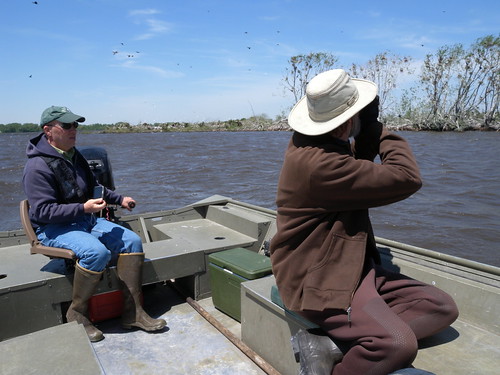
On June 1st, 2011 I assisted biologists Sumner Matteson and Art Techlow conduct bird surveys on Lake Winnebago and Lake Butte des Morts.  The Lake Winnebago survey had been postponed several times because of high winds.  High winds, Lake Winnebago and John boats are not a good mix.  Even this day we had strong winds were.  White caps were forming 50 yards from shore, but this time the direction was out of the west, and so the conditions were not too bad.  Today we were looking specifically for common terns, but also American white pelicans, great egrets and other birds.   
Common terns look similar to gulls, but they are smaller, have knife-shaped wings, and they’re most easily identified by the black caps on their heads.  If you see one of these birds, keep an eye on it.  Likely you’ll see it flying along and pause and hover in mid air.  Suddenly it will drop from the sky as if had a heart attack and plunge into the water.  A moment later it will reappear and head skyward, minnow in beak.  This minnow may be a snack, a gift for a mate, or food for its brood.   

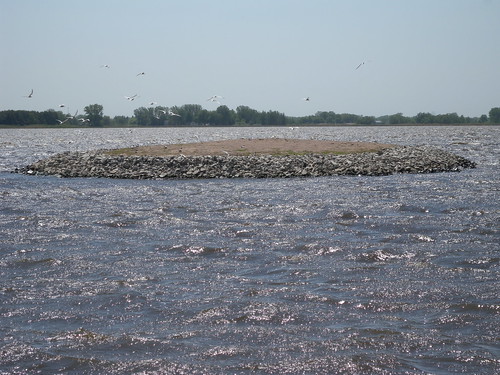
On Lake Winnebago there were no common terns nesting on an island where they had in previous years, because trees had grown up.  Common terns are not common in Wisconsin, in fact they are on the state’s endangered species list.  The main reason is they require nesting sites that are on beaches, or islands far from land predators.  They like a nice view of the horizon and if a site does not have one, they will not nest.  Common terns nest in colonies.  In Wisconsin there are only four, two on Lake Superior and two in Winnebago County.  This island on Lake Winnebago would have been the fifth.  The habitat of common terns has become increasingly scarce as beaches are developed and the sand bars of rivers disappear under reservoirs.  Because of this, the DNR and local partners have constructed two nesting islands, one in Lake Butte des Morts and the other in a large pond between Oshkosh and Winneconne.


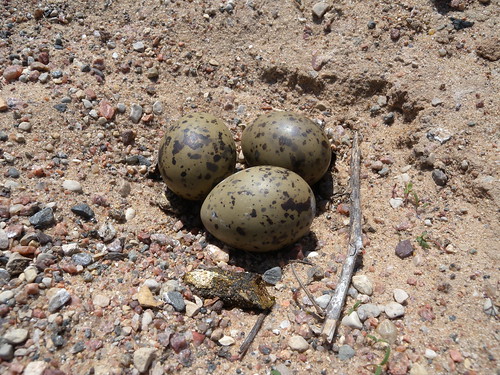
Common Tern Nest and Eggs
After checking Winnebago, the two DNR biologists and I brave the wind and waves of Lake Butte des Morts to check on the man-made island.  A few terns are in the air, and we can make out a few white dots on the island.  As we come, a small cloud of terns rises into the air simultaneously.  I hear a whoop out of a delighted Sumner, and look to Art who has a big grin.  This project works.  On the island I am careful not to crush the camouflaged eggs with my size 13 boots. We count 33 little scrapes in the sand with eggs.  This year it is Wisconsin’s entire breeding population south of Lake Superior, as the island in the pond has been abandoned this season.  Even though these islands are maintained for the terns, the small birds are still under threat from the big feet of pelicans and Canada geese, predatory gulls, and human disturbance.     
Common Tern Nesting Island
Note:  Please stay clear from these islands.  Too much human disturbance can cause the entire colony to abandon the site. 

The endangered Forster’s tern also nests on Lake Poygan, but unlike the common tern it nests on floating mats of vegetation.  The two species look very similar and are most easily differentiated by their calls.  High water and winds blew all the Lake Poygan birds’ nesting material away and they are not nesting here this season.  Much larger Caspian terns also visit the area, but do not breed. 

Tuesday, June 14, 2011

Impacts of Farm Runoff on Our Lakes

How might the runoff from local farms be affecting our lakes and what can farmers do to help protect the Winnebago system?
Eric Cooley, a University of Wisconsin-Extension expert on rural runoff, will address these questions at the next program of the Winnebago Lakes Council Speakers Series. It will be held Wednesday, June 29, at 7:30 p.m. at the Fond du Lac Yacht Club, 705 Mohawk Ave.

Cooley is the research coordinator of Discovery Farms, a UW- Extension program that explores the environmental and economic effects of agricultural practices of participating farms and helps improve communication about these issues.

DIRECTIONS:  Exit 99 of Highway 41 (Route 23 / Johnson Street), east on Highway 23, left onto North Park Avenue, right onto Winnebago Drive, left onto Mohawk Avenue.

Sunday, May 29, 2011

Plant of the Week: American Basswood (Tilia americana)


American Basswood (Tilia americana) Leaves

Basswood (sometimes called Linden) is a tree found in our swamps, but it's also happy on our uplands.  The seeds are dispersed on a unique structure that catches the wind. 
The tree is also a valued street tree, as is its European cousins and hybrids.  The honey made from the flowers of basswood is considered excellent.  Native Americans and pioneers used the inner bark to make rope.  Basswood is prized for its soft clear wood by wood carvers and almost no one else, therefore it ends up in pallets, excelsior, interior furniture parts, etc.

More on American Basswood 


Young American Basswood Bark

 
Old Basswood Bark

Saturday, May 28, 2011

What is a Marsh and what is a Swamp?

Marshes and swamps are two different things. A marsh is a place with standing water or soils saturated with water throughout most of the year, and grass-like vegetation:  cattails, sedges and grasses.  Swamps have the same moisture requirements, but are dominated by trees and shrubs.  They are more often flooded or saturated for shorter time periods.  In coming posts I will discuss the unique characteristics that define specific plant communities.  To help identify these plant communities I recommend a book published by the US Army Corps of Engineers (USACE):  Wetland Plants and Plant Communities of Minnesota and Wisconsin by Eggers and Reed.  You can view the entire book here, or purchase it here.  You can also learn more on my new website by clicking Wetland Plant Communities


An older addition

Shallow, Open Water Communities
Deep Marsh
Shallow Marsh

Local Swamps


Shallow Water Marsh : Poygan State Wildlife Area

Tuesday, May 24, 2011

Myth and Magic


Every now and then nature takes my breath away, burns an image in my mind and leaves me standing with very few words in my vocabulary worthy of the moment.  I had many such moments growing up in the countryside of Waupaca County.  We were up on a hill and could see the woods up close to the north and five miles of farmland and forests to the south.  After I moved out, I still visited often.  One weekend I watched a large cloud building in the afternoon.  Now most clouds move on, but this one stayed.  I can’t remember how long, perhaps five hours.  It started before dinner, and billowed like a giant smokestack until after dark.  When darkness came, the cloud that was already a mysterious life form over the landscape revealed itself as a tortured entity.  It began to glow inside with steady flashes of lightning, boiling light that occasionally lashed out at the ground beneath, while the stars minded their own business above.  I’ve never seen anything like this since and I hope I never do, because some things should only be experienced once, so they can turn to myth and magic. 


Thunderstorm Boils - Purchase Photo


Zoomed In -Purchase Photo